
Most candidates fail the 5km Running test not because they’re unfit, but because they run it wrong. They go out fast, hit lap 8 completely broken, and limp across the finish line—sometimes too slow to qualify.
Here’s what works instead: smart pacing, consistent training, and mental strategy. Nothing fancy. Just discipline.
This guide gives you the exact plan to run 5km in 24 minutes. Whether you’re currently at 26 minutes or haven’t run seriously in years, you can do this in 8-12 weeks. That’s all you need.

Understand the 5km Test: Why It’s Harder Than You Think
Before starting your training, you need to understand what makes the 5km test uniquely challenging compared to other running tests. Therefore, let’s break down the standards and what they actually mean.
The Qualifying Standards for 2024-2025
SSC GD Constable (Most Common Exam):
- Distance required: 5 km (5,000 meters)
- Time limit: 24 minutes
- Pace needed: 12.5 km/h (4:48 per km)
- Track equivalent: 12.5 laps on a 400m standard track
- Critical point: Physical test is mandatory. Failure means elimination.
This is the benchmark for 5km running strategy for men in SSC GD recruitment. If you’re preparing for this exam, this is your exact target.
BSF Constable:
The same standard applies—5 km in 24 minutes. Consequently, your training approach remains identical.
Other Police Recruitment (Various States):
Maharashtra, Gujarat, UP, and Bihar typically require 5 km in 24 minutes. However, some states maintain different standards. Therefore, always verify your specific state’s official notification before planning your training schedule.
Special Case – Ladakh Region:
Candidates from Ladakh only need to complete 1.6 km in 7 minutes, which is significantly easier. Nevertheless, the training principles remain similar.
Indian Army (Important Difference):
The Army requires 1600m in 5:45 minutes, not 5km. Although the 5km training will improve your aerobic capacity, the strategies differ considerably.
Why 5km Running Strategy for Men Is More Challenging Than 1600m
Many candidates underestimate the 5km test because they compare it to shorter distances. Here’s why that’s a mistake:
Distance and Endurance: Five kilometers is three times longer than 1600m. You’re committing to non-stop running for 24 minutes. Your body gets fatigued. Your mind gets fatigued. Around lap 8 (at the 3.2km mark), the real pain begins—not from weakness, but from the accumulation of lactic acid and glycogen depletion.
Mental Toughness Required: During the 1600m test, you can see the finish line approaching. In contrast, during a 5km run, the finish line seems to keep moving away. By lap 10, you’re facing the psychological reality: “I still have two more laps.” This mental battle is where most candidates fail.
Pacing Demands Consistency: For 1600m, you can adjust your pace slightly between laps. However, 5km demands absolute consistency—the same pace for 12.5 laps. Therefore, one poorly-paced lap can destroy your entire race. You need to run approximately 96 seconds per lap, consistently, for the entire duration.
Aerobic System Dominance: While 1600m combines speed with endurance, 5km is pure aerobic effort. Your body must sustain 12.5 km/h for 24 minutes without stopping. Subsequently, your aerobic system needs to adapt to sustained effort, not just speed bursts.
Environmental Factors: By lap 8, you’ve already run for 15+ minutes. The heat becomes a factor. Your legs feel heavy. Mentally, you question whether you can finish. This is precisely where the 5km test distinguishes the prepared from the unprepared.
Honest Assessment: Where Are You Starting From?
Before committing to training, be truthful about your current fitness level. This assessment determines your realistic timeline.
Current Fitness → Timeline to Qualify
If you can currently run 5km in:
- Under 24 minutes: You’re already qualified. Therefore, you need only 1-2 weeks of sharpening.
- 24-26 minutes: Plan for 4-6 weeks of focused training.
- 26-28 minutes: Expect 6-10 weeks of consistent training.
- 28+ minutes: Budget 10-14 weeks of structured preparation.
- Cannot complete 5km without stopping: You need 12-16 weeks, starting with walk-run intervals.
Real Example: If you’re currently running 5km in 28 minutes and your test is in 12 weeks, you need to improve by 4 minutes. That’s achievable with smart training—roughly 20 seconds of improvement per month. Moreover, most candidates who train consistently achieve 30-45 seconds of monthly improvement.
The Physiology: What Happens in Your Body During 5km
Understanding the physiological stages helps you maintain mental toughness during both training and testing. Let’s break down each phase:
The Opening Phase (Minutes 0-5, Laps 1-2)
Your body is still in anaerobic mode. Adrenaline is high. Your muscles are receiving oxygen efficiently. You feel good. This feeling is deceptive. You’ll be tempted to accelerate here. Don’t.
What’s happening physiologically: Your heart rate is climbing rapidly. Glycogen (muscle fuel) is starting to deplete. Oxygen delivery to muscles is optimal. Everything feels manageable.
The critical mistake: Candidates often run laps 1-2 in 110-112 seconds, thinking they’re “warming up.” By lap 6, they’re paying the price with 125-130 second laps. Therefore, discipline yourself to maintain target pace from the beginning.
The Stable Zone (Minutes 5-15, Laps 3-7)
You’ve settled into your rhythm. This is the “good” section where everything feels controlled. Your breathing is elevated but manageable. Your legs feel strong. You’re gaining confidence.
What’s happening: Lactic acid is beginning to accumulate, but not yet at uncomfortable levels. Your aerobic system is working efficiently. Glycogen is being steadily consumed. You’re finding your stride.
The advantage: There’s essentially no danger zone here. If you’re struggling during this phase, you went out too fast in the first 5 minutes. Consequently, you should feel progressively stronger as laps 3-7 unfold.
The Critical Zone (Minutes 15-20, Laps 8-10)
Around lap 8 (after 15+ minutes), reality strikes hard. You still have 9+ minutes remaining. Your legs are getting noticeably tired. Lactic acid buildup becomes real. You’re hot. Breathing is labored.
What’s happening physiologically: Your aerobic system is operating at maximum capacity. Lactic acid accumulation is significant. Glycogen stores are becoming depleted. Mental fatigue sets in simultaneously.
The psychological moment: You do the math: “I’ve been running for 15 minutes. I’ve still got 9 more minutes. Can I actually do this?” This is where 50% of unprepared candidates either slow down dramatically or quit entirely.
How to manage it: You’ve trained specifically for this moment. Your body is physiologically capable. The pain is information, not a stop sign. Push through laps 9 and 10. Surprisingly, laps 11 and 12 feel better because the finish line becomes visible.

The Final Push (Minutes 20-24, Laps 11-12.5)
You can finally see the finish line. You have approximately 4 minutes remaining. Your body is screaming. Your legs are heavy. Your mind is fatigued.
What’s happening: Glycogen is nearly depleted. Your anaerobic system is kicking in desperately. Heart rate is maxed. You’re running purely on mental willpower.
The final sprint: Many runners find a surprising final gear here. Not because they have more energy—they don’t. Rather, because the finish line is visible and close. You can push hard for four more minutes. That’s all you need.
12-Week Training Plan: Your Complete 5km Running Strategy for Men
The journey is structured into four distinct phases. Each phase serves a specific purpose. Follow this progression systematically.
Phase 1: Base Building (Weeks 1-3)
Primary goal: Run 5km continuously at a comfortable, sustainable pace.
Secondary goal: Build aerobic capacity and injury-free movement patterns.
Why this matters: You cannot run fast until you can run long. Therefore, build your foundation first before adding intensity.
Weekly Training Schedule:
| Day | Workout | Details |
|---|---|---|
| Monday | Easy 4 km | Conversational pace—slow enough to hold a conversation. |
| Tuesday | Rest or light stretching | Complete rest. Recovery happens during rest, not running. |
| Wednesday | Moderate 4.5 km | Slightly harder than Monday. Breathing elevated but controlled. |
| Thursday | Easy 3 km | Recovery run. Keep intensity minimal. |
| Friday | Complete rest | No running. Mental and physical recovery. |
| Saturday | Long run 6 km | Slow pace. Nonstop running. 30 minutes for 6km is acceptable. |
| Sunday | Complete rest | Family time and full recovery. |
Total weekly volume: 20.5 km
Additional requirements: Perform strength training twice per week (squats, lunges, planks, calf raises, glute bridges). This prevents injuries and builds lower body resilience. Consequently, you’ll run more efficiently throughout your training.
Success marker: By week 3, you can comfortably run 5km without stopping. You feel capable of handling more intensity.
Phase 2: Race Pace Introduction (Weeks 4-6)
Primary goal: Teach your body what 4:48 per km (target pace) actually feels like.
Why this matters: You need to develop familiarity with your goal pace. When you hit target pace during the test, it should feel familiar, not foreign.
Weekly Training Schedule:
| Day | Workout | Details |
|---|---|---|
| Monday | Easy 4 km | Recovery run. Easy pace only. |
| Tuesday | Speed work: 8 × 400m @ goal pace | Run 400m at target pace (96-100 sec), jog 200m slowly for recovery. Repeat 8 times. |
| Wednesday | Easy 4 km | Recovery focus. Keep it slow. |
| Thursday | Tempo run: 15 min @ “comfortably hard” | Run 15 minutes at a pace where breathing is elevated but you can speak in short sentences. |
| Friday | Complete rest | Full rest day. |
| Saturday | Long run: 6.5 km easy | Slow pace. Continue aerobic base building. |
| Sunday | Complete rest | Recovery and preparation for the week ahead. |
Total weekly volume: 22 km
Critical concept—Target Pace:
For a 24-minute 5km target, you need approximately 96 seconds per 400m (or 115 seconds per lap with minor variation). The 8 × 400m repeats teach your legs to recognize and sustain this pace.
Important training principles:
- Never run easy runs too fast. Most men accelerate easy runs beyond recovery pace.
- Speed work should be challenging but controlled. You should complete all 8 repeats.
- Continue strength training twice weekly without exception.
Success marker: You complete all 8 × 400m repeats at goal pace without completely exhausting yourself. Importantly, you now understand what your target pace feels like in your body.
Phase 3: Speed Endurance Development (Weeks 7-9)
Primary goal: Run your goal pace for extended distances, not just brief repeats.
Why this matters: You’ve mastered 400m repeats. Now you need to string together multiple fast 400m segments into one 5km race. Therefore, this phase builds that specific capacity.
Weekly Training Schedule:
| Day | Workout | Details |
|---|---|---|
| Monday | Easy 4 km | Keep intensity minimal. Recovery focus. |
| Tuesday | Longer repeats: 5 × 800m @ goal pace | Run 800m at target pace (3:50-4:00 min), jog 2 min recovery. Repeat 5 times. Challenging but essential. |
| Wednesday | Easy 4 km | Recovery run. |
| Thursday | Threshold repeats: 10 min @ goal pace, 3 min rest, 5 min @ goal pace | Practice running goal pace for extended periods. |
| Friday | Complete rest | Full rest day. |
| Saturday | Long run: 7 km easy | Build aerobic base. Maintain easy pace. |
| Sunday | Complete rest | Recovery. |
Total weekly volume: 23 km (reduced volume because intensity increased)
Understanding the workouts:
- 800m at goal pace equals approximately 3:50-4:00 minutes per rep. This is significantly harder than 400m repeats.
- You’re running 1.5 laps at race pace, which feels challenging by the 4th or 5th repeat.
- This is where mental toughness develops. Most unprepared runners slow down by repeat 4. Don’t.
Key principle: Push through discomfort in these repeats. You’re specifically training your mind and body for laps 9-10 of the actual test, when fatigue becomes overwhelming.
Success marker: You complete 5 × 800m at goal pace. Additionally, you can sustain 10 minutes at goal pace without falling apart. Your confidence is noticeably growing.
Phase 4: Peaking and Race Preparation (Weeks 10-12)
Primary goal: Sharpen your fitness and build unwavering confidence.
Why this matters: Your body is now trained. The final phase focuses on mental preparation and peak readiness.
Weekly Training Schedule:
| Day | Workout | Details |
|---|---|---|
| Monday | Easy 3 km | Minimal intensity. Maintain fitness, don’t build. |
| Tuesday | 3 × 1000m @ goal pace | Run 1000m at target pace, rest 3 min. Repeat 3 times. Simulates 3km of the race. |
| Wednesday | Easy 3 km | Recovery. Very easy pace. |
| Thursday | 6 × 300m @ 95% effort | Short, fast repeats. Keep legs sharp and responsive. |
| Friday | Complete rest | No running. Mental and physical rest. |
| Saturday | Practice 5km time trial OR easy 4 km | Either run a full 5km at race pace (to assess actual fitness), or run easy to recover. |
| Sunday | Complete rest | Full recovery. |
Total weekly volume: 17 km (significantly reduced, test approaching)
Critical elements for final weeks:
- Sleep 8+ hours every night. Non-negotiable. Your body strengthens during sleep.
- Eat nutritious food. Extra calories support hard training.
- Visualize your perfect race every night (5-10 minutes). See yourself hitting each lap target.
- Develop three mental mantras:
- “I’ve trained systematically. I’m ready.”
- “Control the pace. Pace controls the race.”
- “One lap at a time. I can do this.”
- “Pain is temporary. This goal is permanent.”
Practice race recommendation:
Run a full 5km at race pace during week 10 or 11. This reveals your actual fitness level. Make training adjustments based on reality, not hope.
Success marker: You’ve successfully run 5km at goal pace in training. You feel genuinely confident. You know the pace intimately. Now it’s simply about execution.
Race Day Execution: How to Run 5km in 24 Minutes
You’ve completed 12 weeks of training. Now let’s discuss the actual test strategy.
The Two Hours Before Your Test
Two hours before the test:
- Eat a light breakfast: banana, toast, tea or coffee
- Drink approximately 500ml of water (not too much—you’ll feel bloated)
- Use the toilet
- Do light, easy stretching
Forty-five minutes before:
- Warm-up jog: 10 minutes at easy pace
- Dynamic stretching: leg swings, arm circles, walking lunges
- 3 × 50m acceleration runs at 80% effort (to activate your legs)
Fifteen minutes before:
- Go to the starting line
- Take three deep breaths
- Tell yourself: “I’ve trained systematically. I know this pace. I’m ready.”
- Shake out your legs to release tension
- Stop analyzing. Begin executing.
Your Pacing Strategy: The Most Critical Element
Five kilometers equals 12.5 laps. Your target is 96 seconds per lap consistently (or 4:48 per km).
Here’s how to pace each critical section:
Lap 1 (0-400m): Target 112 seconds
Adrenaline is high. You can afford slightly faster pacing. Therefore, 112 seconds feels controlled and appropriate. However, don’t sprint. You have 23+ minutes remaining.
Laps 2-3 (400-1200m): Target 115 seconds each
Settle into your rhythm. Breathing is elevated but controlled. You feel strong. You’re tracking perfectly for a 24-minute finish.
Laps 4-7 (1200-2800m): Target 115 seconds each
This is the easy section. Everything feels good. You’re running smoothly. Your legs feel strong. Maintain consistent pace. Moreover, this section builds confidence for later.
Laps 8-10 (2800-4000m): Target 115-120 seconds
This is the HARD section—the critical zone. Lactic acid is building noticeably. Your legs feel tired. You want to slow down. Don’t. Push through. This is where races are won or lost. Your training prepared you specifically for this moment.
Laps 11-12 (4000-4800m): Target 115 seconds
You can finally see the finish line. You have approximately 5 minutes remaining. You’re hurting, but you know it’s almost complete. Keep the pace consistent.
Final 0.5 lap (4800-5000m): All-out effort
Give everything you have. Sprint the final 200m. Empty the tank completely.
Realistic total time: Approximately 23 minutes (you’ll likely finish 20-45 seconds under 24 minutes if you execute this strategy perfectly).
Mental Strategies During the Race
Around lap 5 (at 2km, approximately 9 minutes):
Everything feels good. You’re thinking confidently: “I’ve got this.” However, don’t become overconfident. You’re only 40% finished. Stay focused on pace.
Around lap 8 (at 3.2km, approximately 15 minutes):
This is THE critical moment. You’re genuinely tired. You have 9+ minutes remaining. Your mind is telling you to slow down. Resist this impulse. Acknowledge the discomfort, then push harder. Tell yourself: “I’ve trained for this. My legs are strong. I can push harder.”
Focus on your form: drive your knees higher, pump your arms more forcefully, maintain upright posture.
Around lap 10 (at 4km, approximately 19 minutes):
Finally, you can see the finish line approaching. You’ve got maybe 5 minutes remaining. You’re hurting significantly, but you’re close. Mental mantra: “Just 5 more minutes. That’s nothing. I can do 5 minutes.”
Final lap (lap 12.5):
Give all-out effort. Push as hard as physically possible. The finish line is close. Lean slightly at the finish.

Nutrition: Fuel Your Training and Test Performance
You cannot train hard on an empty stomach. Therefore, proper nutrition is essential for both training and test success.
Daily Nutrition Plan
Breakfast (most important meal):
- 2-3 whole wheat rotis with dal, eggs, or paneer
- 1 glass of milk
- 1 banana
- Timing: Eat this 30-45 minutes after waking
Mid-morning snack (2-3 hours before hard training):
- Banana or peanut butter sandwich
- This provides energy without causing digestive heaviness
Lunch (main meal):
- 1.5 cups rice with 1 cup dal/chicken/paneer
- Vegetables (spinach, carrots, broccoli)
- 1 glass yogurt or buttermilk
- Timing: Eat 2-3 hours before hard workouts, or 1.5 hours before easy runs
Post-workout (within 30 minutes):
- Banana and glass of milk
- OR rice with simple curry (quick and effective)
- This accelerates recovery
Evening snack:
- Apple or orange
- Handful of almonds
- 1 glass milk
Dinner:
- 2-3 rotis with vegetables and 100g protein
- Lighter than lunch (avoid heavy meals before bed)
Throughout the day:
- Drink 3-4 liters of water
- Don’t wait until thirsty—drink proactively
Nutritional Priorities
Carbohydrates (your primary fuel):
Rice, bread, oats, sweet potatoes. These are your energy source for running.
Protein (muscle building and recovery):
Eggs, chicken, paneer, dal, yogurt. Target 1.2-1.6g per kg of body weight daily.
Healthy fats (hormonal balance):
Nuts, seeds, olive oil. These support overall hormonal function.
Foods to Avoid
- Fried food and junk food (especially before running)
- Heavy meals right before training
- Excessive sugar and refined carbohydrates
- Alcohol (drastically reduce consumption during training)
- Energy drinks (water is sufficient for runs under 60 minutes)
Recovery: Where the Real Adaptation Happens
You get faster while resting, not while running. Most candidates don’t understand this critical principle and consequently overtrain.
Daily Recovery Practices
Sleep (absolutely most important):
- 7-8 hours every night. Non-negotiable.
- Your body strengthens and adapts during sleep.
- Better sleep directly equals faster running.
Stretching routine:
- 10 minutes after every run
- Focus on: calves, hamstrings, quads, hip flexors, glutes
- Hold each stretch for 30 seconds
- Improves flexibility and reduces injury risk
Recovery days (essential):
- Easy runs should be genuinely easy—not moderately fast
- Rest days should be complete rest or light walking only
- Never perform hard workouts on consecutive days
- Your body needs recovery time to adapt
Strength training (twice weekly):
- Squats, lunges, planks, calf raises, glute bridges
- 15-20 minutes per session
- Prevents injuries and builds running power
- Non-negotiable for injury prevention
Foam rolling or massage (if available):
- 5 minutes on legs after hard workouts
- Reduces muscle tightness
- Improves blood circulation
Common Mistakes Men Make in 5km Training
Learning from others’ errors accelerates your success. Therefore, avoid these frequent mistakes:
Mistake 1: Starting Too Fast
- Runners begin lap 1 in 105-110 seconds, thinking they’re “warming up”
- By lap 6, they’re severely fatigued
- Solution: Run lap 1 at goal pace (115 seconds). It feels conservative but it’s correct.
Mistake 2: Underestimating Mental Difficulty
- Candidates think, “I can run 5km; it’s just distance”
- At lap 8, they realize they still have 9 minutes and mentally break down
- Solution: Mental training equals physical training. Visualize daily. Develop mantras.
Mistake 3: Not Practicing on the Actual Track
- Training on roads differs significantly from track running
- Roads have rolling terrain and softer surfaces
- Track is flat, hard, and unforgiving
- Solution: Complete at least 4-5 workouts on your actual test track before race day
Mistake 4: Skipping Strength Training
- Candidates assume running alone suffices
- Weak muscles lead to injury
- Solution: Strength train twice weekly without exception
Mistake 5: Poor Nutrition During Training
- Candidates eat lightly, thinking they’ll run faster
- Instead, their bodies lack fuel
- Solution: Eat sufficient calories, especially carbohydrates and protein
Mistake 6: Inadequate Sleep
- Candidates cut sleep while studying for written exams
- Their bodies crash from fatigue
- Solution: Sleep is training. 7-8 hours every night.
Mistake 7: Not Practicing Race Pace in Training
- Candidates do easy runs and speed work but never practice actual race pace
- Test day arrives and the pace feels unfamiliar
- Solution: Run goal pace every single week. Develop intimacy with your target pace.
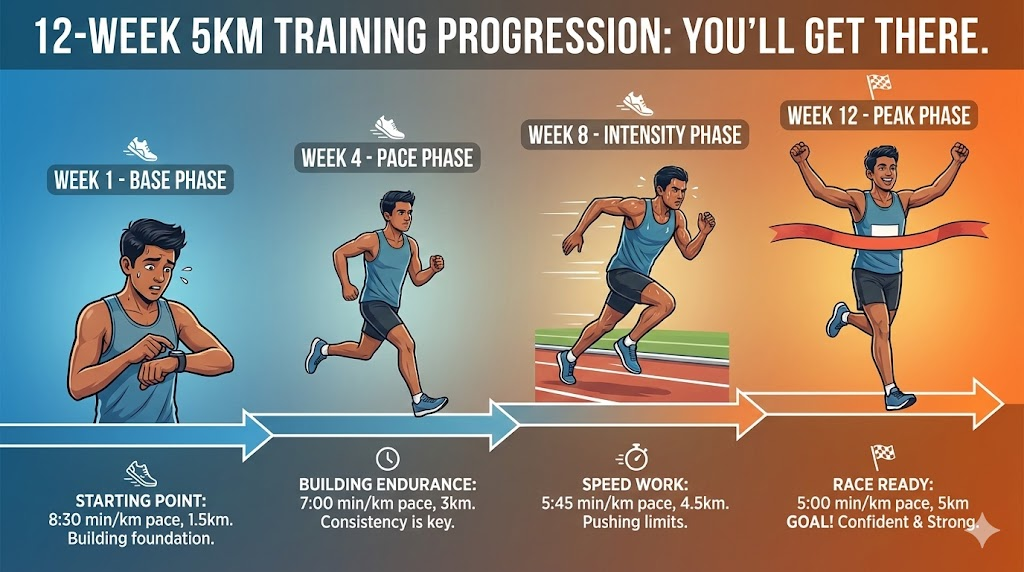
Your Complete 12-Week Summary
Here’s your quick reference guide:
Weeks 1-3: Base Building Phase
- Easy 3-4 km runs, long runs up to 6 km
- Total: approximately 20 km per week
- Focus: Build distance, remain injury-free
Weeks 4-6: Race Pace Introduction
- Introduce 400m repeats at goal pace
- Add tempo runs
- Total: approximately 22 km per week
- Focus: Learn what pace feels like
Weeks 7-9: Speed Endurance Development
- 5 × 800m at goal pace
- 10-minute threshold runs
- Total: approximately 23 km per week
- Focus: Run goal pace for longer distances
Weeks 10-12: Peaking Phase
- 3 × 1000m at goal pace
- 6 × 300m fast repeats
- Total: approximately 17 km per week (reduced for rest)
- Focus: Sharpen, build confidence, execute
Pre-Test Readiness Checklist
Before stepping onto that track for your actual test, confirm these elements:
- Can run 5km continuously at goal pace in training
- Completed at least 2 full 5km time trials at race pace
- Know your goal pace (96 seconds per lap) by heart
- Strength trained twice weekly consistently
- Slept 7+ hours nightly for the past week
- Ate nutritious food without restrictive dieting
- Run on the actual test track at least 4-5 times
- Know the track layout (finish line location, lap markers)
- Developed three mental mantras
- Visualized your perfect race every night for two weeks
- Pre-race routine is solid and practiced
- Feel genuinely ready to execute
Final Words: You’ve Got This
The 5km test will be challenging—the hardest 24 minutes of your training journey. However, hardship doesn’t mean failure. Rather, it means your mind will be tested as much as your body. That’s where strategy matters.
Thousands of men pass this test yearly. They succeed not because of innate talent, but because they showed up consistently, trained intelligently, and refused to quit when pain arrived. Therefore, you can too.
You have 12 weeks. That’s sufficient time. Follow this plan. Trust the process. Push through the difficult moments.
On test day, when you hit lap 8 and your legs are screaming, remember: You trained specifically for this. Your body is physiologically ready. Your mind is stronger than the pain.
Now go crush this 5km running strategy for men. Your government job awaits.