Discover the best jobs in 2026 with AI-first focus. From machine learning engineers to cybersecurity specialists, explore
Dreaming of $100K+ salaries in 2026? The best jobs in 2026 aren’t traditional roles—they’re AI-powered careers exploding worldwide. Forget the myth that AI steals jobs. AI creates winners: engineers building autonomous agents, cybersecurity experts guarding intelligent systems, data wizards fueling machine learning, and green innovators using AI to fight climate change.
With 97 million new AI jobs predicted by 2025 (and 2026 accelerating), companies are desperate for talent. But here’s the truth: best jobs in 2026 won’t go to Python beginners—they’ll go to builders with real portfolios.
This guide reveals 8 best jobs in 2026 with exact skills, tools, projects, and salaries. Whether you’re a student, fresher, or career switcher, your 90-day roadmap starts here. Ready to land one of the best jobs in 2026?
Why 2026 is the AI-First Job Year
Picture this realistic scenario: AI agents handling 40 percent of office work that humans currently do. Smart infrastructure predicting equipment failures before they happen. Personalized learning replacing the broken one-size-fits-all education system. Generative AI creating marketing content, writing code, designing graphics, and handling customer support.
Microsoft unveiled their seven AI trends for 2026. They’re talking about AI agents everywhere that can handle tasks autonomously. Multimodal AI understanding text, images, and voice together. AI governance becoming critical as ethics and safety become non-negotiable. Edge AI moving computation from the cloud onto your phone. And sustainable AI because energy consumption is becoming a real problem.
The result? Companies need AI builders who construct these systems. They need AI protectors for security. They need AI scalers for massive scale. They need AI integrators connecting AI to existing business processes. Traditional jobs are disappearing. AI-enabled jobs are exploding right now.
Top 8 Jobs in 2026 With High Demand
These are verified high-demand roles based on LinkedIn hiring data, World Economic Forum reports, and what companies are actively searching for right now. For each job, I’ll explain what you do, why companies need you, what skills matter, and how to enter that field.
1. AI and Machine Learning Engineer
Your job is building AI models that predict, generate, or classify things. Netflix figuring out shows you’ll watch. Banks detecting fraud. Hospitals diagnosing diseases. That’s all AI engineers making it real.
Why is demand exploding? Eighty-five percent of companies want AI by 2026, but only a tiny fraction have the engineers to build it. Everyone wants to be an AI company. Almost nobody knows how.
Salary: $120,000 to $200,000 USD in the United States. In India, senior AI engineers make 30 to 80 lakh rupees annually.
How to learn (90 days):
Start with Python basics. Don’t spend two weeks on basics. Spend four or five days. Learn NumPy and Pandas. Take Andrew Ng’s machine learning course—it’s genuinely one of the best introductions. Then build actual projects immediately. A classification model. A recommendation system. Anything real. Compete on Kaggle. Learn from others. Build your GitHub portfolio. By day 90, you need three real projects showing you can build AI.
2. MLOps Engineer (Machine Learning Operations)
You take AI models that researchers build on laptops and get them running in real production systems. You build pipelines. You monitor when things break. You scale systems handling millions of requests per second.
Here’s the truth: ninety percent of AI projects fail at deployment. The model works in the lab, but production breaks everything. MLOps engineers fix that. Companies are desperately searching.
Salary: $130,000 to $180,000 starting.
Skills needed: Docker, Kubernetes, CI/CD pipelines, monitoring, debugging at scale, cloud platforms like AWS SageMaker or Azure ML.
Entry path: Take Udacity’s MLOps nanodegree or self-teach by deploying two models to cloud yourself. Make them work. Monitor them. That’s real experience.
3. Cybersecurity Specialist (AI Security Focus)
Think of this role as AI’s bodyguard. As companies deploy more AI, hackers get smarter finding new attacks. They poison training data. They trick AI with adversarial inputs. They steal models.
Cybersecurity demand was already high, but adding AI creates urgency. Cybercrime losses hit $10.5 trillion by 2025 globally. Companies will pay serious money to protect themselves.
Salary: $110,000 to $160,000.
Path: Get CompTIA Security+ certification. Learn ethical hacking. Understand cloud security. Work as junior in security operations center. Then specialize in AI security.
4. Data Engineer
Build pipelines that feed AI clean, fast data. Here’s the saying: garbage in, garbage out. Bad data means bad AI decisions. Good data means brilliant AI.
Why demand explodes? Every company wants AI. AI needs data. Data engineers are critical.
Salary: $115,000 to $170,000.
Skills: SQL deeply, Python, Apache Spark, Kafka, cloud data warehouses like Snowflake.
Learning path: DataCamp has excellent SQL and Python tracks. Build a real ETL pipeline project. Move data from source systems to data warehouse. Handle transformations. Put it on GitHub.
5. Cloud AI Engineer
AI engineering specifically on cloud platforms like AWS, Azure, or Google Cloud. As AI workloads grow, companies can’t run them locally. They need cloud infrastructure.
Salary: $125,000 to $180,000.
Requirements: AWS SageMaker, Azure ML, Google Cloud Vertex AI, Kubernetes.
Entry: Get AWS Machine Learning Specialty certification. Build two SageMaker projects. Deploy and monitor them. You’re now a junior cloud AI engineer.
6. AI Product Manager
You decide what AI to build, not how it’s built. Engineers handle building. You handle deciding what solves real problems for real people.
Why this matters? Companies built tons of AI nobody uses. Wrong problem. Wrong audience. Wrong approach. AI Product Managers prevent that.
Salary: $140,000 to $200,000 (higher than some engineering roles).
Skills: Product thinking, user research, basic AI literacy for engineer conversations, stakeholder management.
Entry: Start in product at any company, then move to AI company. Or start technical, show product thinking, transition.
7. Generative AI Specialist
Master tools like GPT-5, DALL-E, Midjourney. Use them to solve real problems. Marketing creates content faster. Design generates variations instantly. Development codes faster.
Salary: $100,000 to $160,000.
Skills: Prompt engineering mastery, API integration, creative thinking about applications.
Path: Learn prompt engineering deeply. Take available courses on these APIs. Build three actual products and launch them. Show real business value.
8. Green AI Engineer
Create AI that doesn’t destroy the environment. AI uses about two percent of global electricity. That’s significant and growing. Green AI engineers optimize models to use less energy, run on edge devices instead of massive data centers.
Salary: $120,000 to $170,000.
Focus: Model optimization, edge AI deployment, carbon tracking, energy-efficient algorithms.
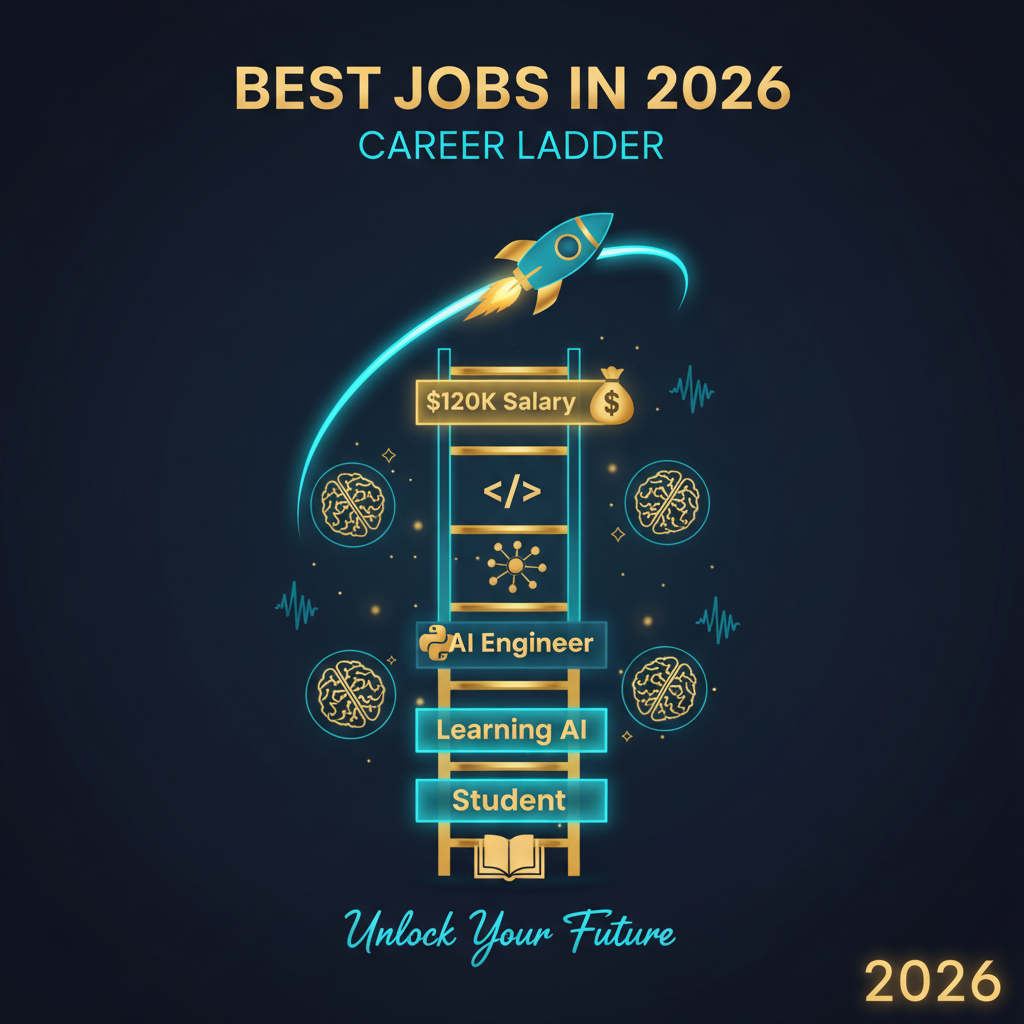
Your 90-Day Action Plan
You cannot become world-class in ninety days. But you can become someone companies hire, learn on the job, and start your career. Here’s what works:
For AI Engineer: Start Python basics. Don’t spend weeks. Spend five days. Jump to machine learning. Build immediately. Classification model. Recommendation system. Something real. Compete on Kaggle. Build GitHub portfolio. By day 90, three real projects.
For Data Engineer: Learn SQL properly—ninety percent of data engineering is SQL. Then Python. Then understand ETL and data pipelines. Build a real project: extract data, transform it, load to data warehouse. Put it on GitHub with documentation.
For Cybersecurity: Take CompTIA Security+ seriously. Study two months. Take exam. Then learn AI security specifically. That’s your differentiation. You’re not just security. You’re security understanding AI threats.
For GenAI Specialist: Use ChatGPT seriously. Learn prompt engineering. Read books about it. Learn the APIs. Build three products. Chatbot. Content generator. Something making money or solving problems. Launch it.
What Kills Your Chances
People try learning everything at once. AI, cloud, security, data—all of it. They become experts at nothing. They build projects but never finish or share them. No GitHub profile. YouTube tutorials but never coding themselves. Waiting for “perfect” moments instead of applying today.
What works: Pick one track. Go deep. Build one genuine project solving real problems. Get on LinkedIn and be active. Apply to fifty jobs. You’ll get rejected from forty-eight. But two will give you a chance.
Real Salary Expectations for 2026
In the United States, junior AI roles start at ninety to one hundred twenty thousand dollars. Within two years, you’re at one hundred fifty to one hundred eighty thousand. Senior roles hit two hundred to three hundred thousand.
In India, junior AI engineers start at eighteen to twenty-five lakh rupees. Senior engineers hit fifty to eighty lakh. That’s real money changing your life.
Remotely, companies globally hire from India, meaning you work for US or EU companies earning those salaries while living in India. That’s one of the best opportunities available.
Start Today, Not Tomorrow
The most important part isn’t actually the technical stuff. It’s the mindset. 2026 isn’t about waiting for perfect jobs. It’s about building something, showing the world, and letting opportunities find you. It’s continuous learning because AI moves fast. It’s being helpful to others in your journey.
Start today. Not tomorrow. Not next week. Not when you’ve learned “enough.” Start with what you have. Python basics. ChatGPT access. Free Google Colab. Free AWS tier. That’s enough.
The AI jobs are real. The salaries are real. The opportunity is real. The only question is whether you’re serious enough to actually do it.