
Mandatory Vehicle-to-Vehicle (V2V) Communication by 2026: Is India Ready?
Union Minister Nitin Gadkari wants all cars to “talk” to each other by 2026. We decode the mandatory V2V proposal, the ₹5,000 cost impact, and whether it can actually fix Indian road safety.
From Airbags to “Talking Cars”
If there is one thing we know about Union Minister Nitin Gadkari, it is that he doesn’t do things by halves. First, it was the push for 6 airbags. Then came Bharat NCAP. Now, as we step into 2026, the Ministry of Road Transport and Highways (MoRTH) has dropped its biggest tech bombshell yet: Mandatory Vehicle-to-Vehicle (V2V) Communication by the end of 2026.
The goal? To make Indian drivers “talk to each other like pilots,” as Gadkari put it.
But let’s pause the applause for a second. We are talking about a country where people buy dummy clips to stop seatbelt alarms. Implementing a high-tech communication web across millions of vehicles in less than 12 months is a monumental task. As an automotive journalist who has seen regulations come and go, here is my deep dive into what this proposal actually means for you, your wallet, and your safety.
What is V2V Communication? (In Simple Terms)
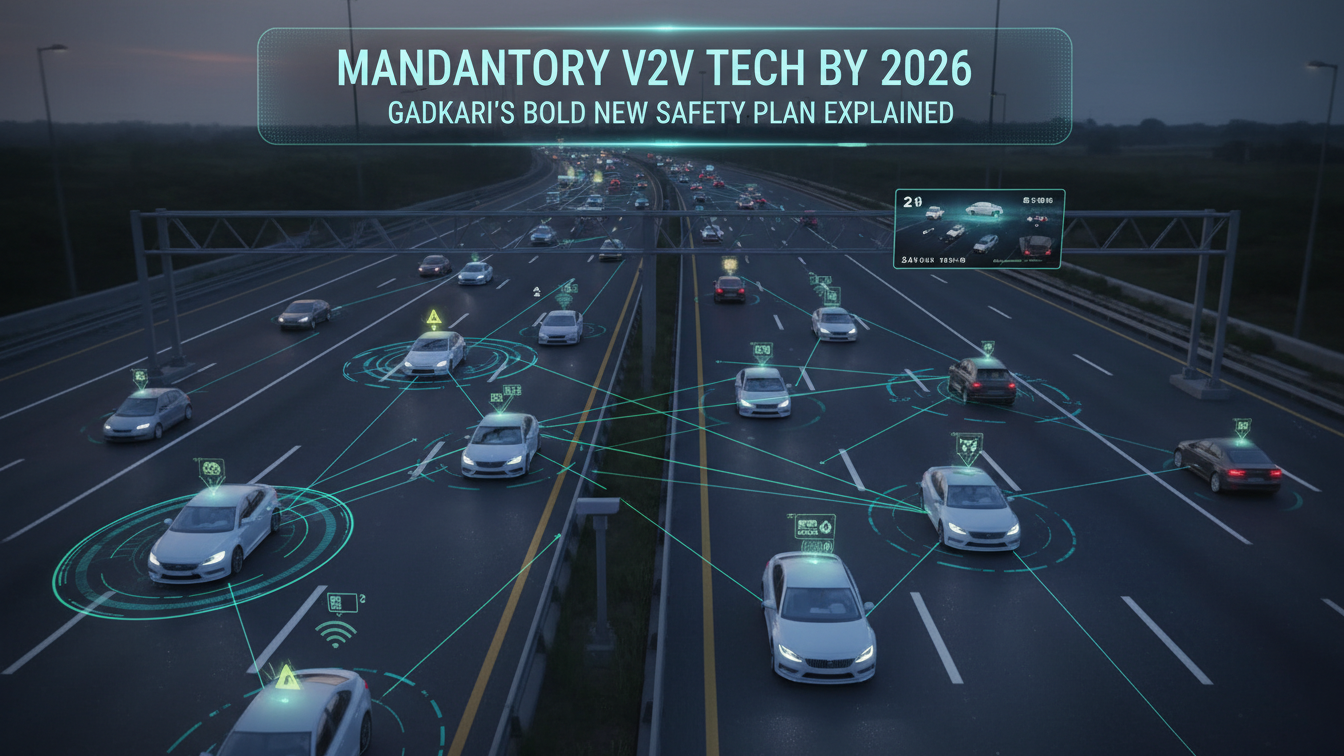
Imagine you are driving on the Yamuna Expressway in dense fog. You can’t see 10 meters ahead. Suddenly, a car 200 meters ahead of you slams on its brakes.
- Without V2V: You don’t see it. You keep driving at 80 km/h until you see tail lights, panic brake, and potentially crash.
- With V2V: Your car receives a digital “shout” from the car ahead instantly: “Emergency Braking Ahead!” Your dashboard flashes a red warning, or your car automatically slows down before you even see the danger.
The Tech Specs:
- The Hardware: An “On-Board Unit” (OBU) fitted inside your car.
- The Spectrum: The Department of Telecommunications (DoT) has agreed to clear the 5.875-5.905 GHz band (30 MHz) specifically for this. Think of it as a private radio channel just for cars.
- The Range: Usually works up to 300–500 meters, far better than cameras or radar which need “line of sight.”
The Proposal: What is Coming in 2026?
According to reports from Autocar India, here is the roadmap the government is looking at:
- Mandatory Timeline: The target is to have this system roll out by the end of 2026.
- Phase 1: Mandatory for all NEW vehicles first.
- Phase 2: This is the tricky part—Retrofitting older vehicles. Yes, the government wants buses, trucks, and eventually older cars to install these units too.
- Cost: The estimated cost of the OBU is ₹5,000 – ₹7,000.
Real-World Impact: Why Do We Need This?
India sees over 1.7 lakh road deaths annually. We need more than just good roads; we need smarter cars. Here is where V2V shines in Indian conditions:
1. The Fog Problem
Every winter, we see massive pile-ups on North Indian highways. V2V doesn’t need “eyes”; it uses radio waves. It can “see” through fog, rain, and dust.
2. The “Blind Turn” Menace
Driving in the Ghats or hilly regions? V2V can warn you if a bus is coming up fast around a blind hairpin bend, giving you time to move over.
3. Intersection Collisions
In India, traffic signals are often “suggestions.” V2V can warn you if a car is speeding towards the intersection from a crossroad and isn’t slowing down, potentially preventing a T-bone crash.
The “Viability” Reality Check: Can We Do It?
This is where the journalist in me gets skeptical. The intent is noble, but the execution timeline (End of 2026) is incredibly aggressive.
1. The Cost Burden
Car prices have already skyrocketed. Adding another ₹7,000 (plus taxes, wiring, and integration costs) will likely push the final price hike to ₹10,000 – ₹12,000 per car. In the budget segment (Alto, Kwid, S-Presso), margins are thin. Manufacturers will pass this 100% to the customer.
2. The “Retrofit” Nightmare
Installing an OBU in a new Tata Punch is easy—it’s built into the wiring harness. But installing one in a 10-year-old truck or a basic Bolero pickup?
- How will it power itself?
- Where will the display go?
- Who ensures the driver doesn’t just unplug it? Retrofitting creates a massive logistical challenge and opens a market for cheap, non-functional “dummy” units just to pass inspection.
3. Standardization
A Maruti OBU must be able to talk to a Mercedes OBU, which must talk to a Tata truck OBU. If they speak different digital languages, the system fails. Developing a “One Nation, One Standard” protocol usually takes years, not months.
4. Privacy Concerns
Your car is constantly broadcasting its location, speed, and direction.
- Who owns this data?
- Can the police tap into it to issue speeding tickets automatically?
- Can hackers track high-value cars? Without a robust Data Protection Law specifically for auto-tech, this is a privacy minefield.
Expert Verdict: A Great Idea, But Timed Too Tight
My Honest Take: V2V is the future. It is superior to ADAS in many ways because it is cooperative. However, targeting a nationwide rollout by the end of 2026 feels more like a “moonshot” goal than a hard deadline.
What will likely happen?
- We will see it mandatory for Commercial Vehicles (Trucks/Buses) first. This makes the most sense as they cause the most severe accidents.
- It might be introduced as “optional” or mandatory only for cars above ₹10 Lakh initially.
- The retrofitting plan will likely be delayed or watered down because enforcing it on India’s 30 crore existing vehicles is a logistical impossibility right now.
Should you worry? If you are buying a car now, don’t worry. This won’t affect you immediately. But if you are waiting for a late 2026 purchase, be prepared for a slight price hike and a new “V2V” brochure feature.
FAQs: V2V in India
Q1: Will my current car need this device? A: The proposal mentions retrofitting in later phases, but historically, such mandates usually apply to new cars first. It is unlikely you will be forced to install this in your personal car immediately in 2026.
Q2: Will this increase car insurance premiums? A: Actually, it might lower them in the long run! If V2V reduces accidents, insurance companies may offer discounts to cars equipped with this tech, similar to “Telematics” discounts abroad.
Q3: Does V2V mean the car will brake for me? A: Not necessarily. V2V provides the warning. Whether the car brakes automatically depends on if the car has AEB (Autonomous Emergency Braking) hardware. In budget cars, it might just be a loud beep.
Q4: Can V2V work without 5G/Internet? A: Yes! V2V uses “Direct Short Range Communication” (DSRC) or C-V2X direct mode. It talks directly car-to-car. It does not need a SIM card or mobile tower to warn you about a crash.
Q5: Who pays for the device? A: You do. The cost (approx ₹5,000-₹7,000) will be added to the ex-showroom price of the vehicle.
Next Step: This topic involves a lot of technical jargon. Would you like me to create a simple “V2V vs ADAS” comparison table to help you understand the difference between what cars have now vs what they will have then?