We have all been there. You open a bank account, forget about it for a few months, and when you finally check the balance—Are baap re! The money is less than what you deposited. Why? Because of those annoying “Non-Maintenance Charges.”
In 2026, managing money should be simple, not a penalty game.
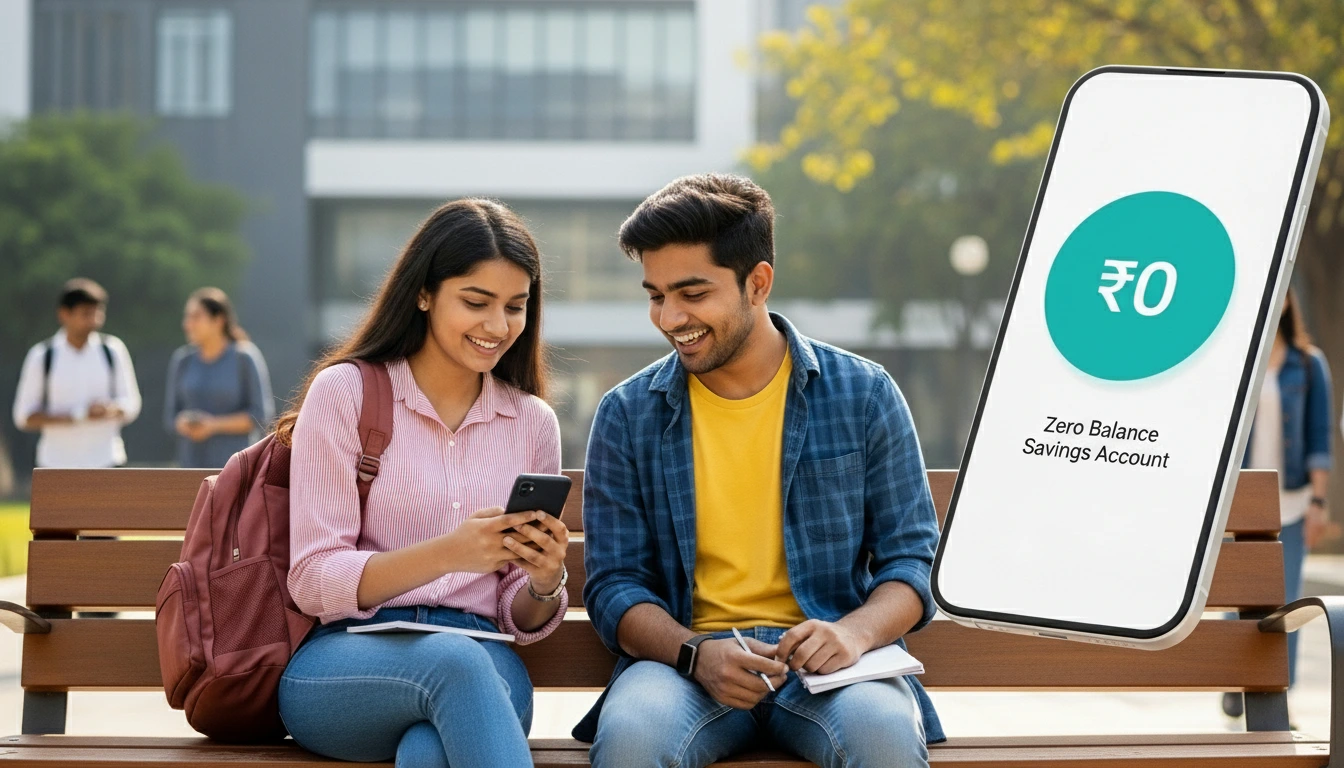
For students, freelancers, and anyone starting their financial journey, keeping ₹10,000 or ₹20,000 locked in an account just to avoid fines makes no sense. This is where Zero Balance Savings Accounts come in. They are exactly what they sound like: accounts where you don’t need to maintain a minimum balance. Even if your account hits ₹0, the bank won’t charge you a single rupee as a penalty.
But with so many banks advertising “Free Accounts,” which one is actually good? Which one has hidden charges for Debit Cards?
In this guide, I’m breaking down the best zero balance savings accounts in India for 2026. Whether you are a college student in Pune or a freelancer in Bangalore, this guide will help you choose the right bank without the confusion.
What Is a Zero Balance Savings Account?
Let’s keep it simple.
A regular savings account usually requires a Monthly Average Balance (MAB). For example, if you open a standard account with a private bank, they might ask you to keep an average of ₹10,000 in the account. If the balance drops below this, they deduct a penalty (often ₹500 + GST).
A Zero Balance Account removes this condition.
You can keep ₹1,00,000 or ₹0—it doesn’t matter. The bank provides you with basic banking facilities like a debit card, passbook, and net banking without the pressure of maintaining a minimum amount.
Why is this trending in 2026?
Because digital banking has taken over. Most of these accounts are now “Digital First,” meaning you can open them from your bedroom using Video KYC, without visiting a branch.
Benefits of a Zero Balance Account
Why should you consider switching?
- No Minimum Balance Tension: Use your money freely. If you need to withdraw everything for an emergency, you won’t be penalized.
- Full Digital Access: Almost all major banks offer robust Net Banking and Mobile App support for these accounts.
- UPI Ready: These accounts work perfectly with Google Pay, PhonePe, and Paytm.
- Basic Debit Card: You get an ATM card (RuPay, Visa, or Mastercard) for withdrawals and shopping.
- Safe & Regulated: These are legitimate accounts governed by RBI guidelines.
Things to Check Before Opening One
Before you jump in, remember that “Zero Balance” doesn’t mean “Zero Charges” for everything. Here is what you need to watch out for:
- Debit Card Fees: While the account is free, the physical debit card usually has an annual fee (₹200–₹500).
- Transaction Limits: Some accounts (especially PSU banks) limit you to 4 free withdrawals per month.
- Interest Rates: Zero balance accounts sometimes offer slightly lower interest rates than premium accounts, though this is changing in 2026.
- Hidden Charges: Check for SMS alert charges or fees for chequebooks.
- Branch Support: Some digital accounts don’t allow comprehensive branch service; they expect you to do everything via the app.
Best Zero Balance Savings Accounts in India (2026)
Here is my honest review of the top contenders this year.
1. Kotak 811 Digital Bank Account
Kotak Mahindra Bank revolutionized the zero-balance game years ago, and in 2026, the Kotak 811 is still a top favorite, especially for urban users.
- Account Overview: It is a fully digital account. You can open it via the Kotak app using your Aadhaar and PAN.
- Key Features:
- Lifetime Zero Balance (no hidden MAB rules).
- Free Virtual Debit Card (works for online shopping).
- Seamless integration with the Kotak Mobile App (which is very smooth).
- Interest Rate: Competitive rates (check the official website for the latest 2026 slabs).
- Pros: Very fast opening process, great app interface, free virtual card.
- Cons: The physical debit card costs money (approx ₹299/year). If you deposit cash at a branch, there might be a fee.
- Who Should Open: Students and digitally savvy users who mostly use UPI/Online payments.
2. SBI Basic Savings Bank Deposit (BSBD) Account
The State Bank of India (SBI) is the trust factor for millions. The BSBD account is RBI-mandated to be zero balance.
- Account Overview: This is a no-frills account meant for the common man. It is not a “digital” fancy account, but a solid basic account.
- Key Features:
- No minimum balance requirement.
- A Basic RuPay Debit card is issued for free (no annual charges).
- Interest Rate: Same as regular SBI savings accounts.
- Pros: Massive ATM network, trust of a government bank, zero charges for the card.
- Cons: Strict Limit: You can only make 4 free cash withdrawals per month (including ATM and Branch). Also, you cannot hold any other savings account with SBI if you open this.
- Who Should Open: People in rural areas, or those who want a secondary account strictly for savings and minimal withdrawals.
3. AU Small Finance Bank Digital Savings
In 2026, Small Finance Banks (SFBs) are offering some of the best interest rates to attract customers. AU Bank is a strong contender here.
- Account Overview: A high-interest yielding digital account with zero balance maintenance requirements (on specific variants like the Digital Savings).
- Key Features:
- Monthly interest payout (a unique feature).
- Video KYC opening process.
- Offers rich debit card features and lifestyle benefits.
- Interest Rate: Usually higher than traditional big banks (up to 7%* depending on slabs).
- Pros: High interest, monthly payout feels rewarding.
- Cons: Branch network is smaller compared to SBI or HDFC.
- Who Should Open: Freelancers and professionals who want their idle money to grow faster.
4. Axis Bank Digital Savings Account
Axis Bank often has different names for its digital products (formerly ASAP), but their digital offering remains popular.
- Account Overview: This is a convenient account for those who want access to Axis Bank’s offers (like Flipkart discounts) without locking in huge funds.
- Key Features:
- Instant digital opening.
- Access to Axis Bank’s excellent offers on e-commerce sites.
- Important Note: Sometimes, Axis asks for an “Initial Funding” (e.g., deposit ₹5000 during opening), which you can withdraw later. Always check the current terms.
- Pros: Great for shopping discounts and loans.
- Cons: SMS charges and debit card fees are slightly higher than PSUs.
- Who Should Open: Shopaholics and salaried employees.
5. ICICI Bank Insta Save / BSBD Account
ICICI is known for its speed and service. Like SBI, they offer a Basic Savings Bank Deposit (BSBD) account which is strictly zero balance.
- Account Overview: A reliable account with one of the best mobile banking apps (iMobile) in India.
- Key Features:
- Zero balance commitment.
- Free Rupay card (for BSBD variant).
- Pros: iMobile app is fantastic; customer service is generally faster than PSUs.
- Cons: Just like SBI, the BSBD account has withdrawal limits (usually 4 per month). If you exceed this, they might convert it to a regular account or charge fees.
- Who Should Open: Those who want private bank service without the ₹10,000 MAB requirement.
Quick Comparison: Top Zero Balance Accounts
| Bank Name | Minimum Balance | Physical Debit Card Fee | Best For |
| Kotak 811 | ₹0 | Paid (approx ₹299/yr) | Online Users / Students |
| SBI BSBD | ₹0 | Free (RuPay) | Rural / Safe Savings |
| AU Small Finance | ₹0 | Varies (Check variant) | High Interest Seekers |
| ICICI BSBD | ₹0 | Free (RuPay) | Family / Basic Use |
| IndusInd Digital | ₹0 | Paid | Flexible Banking |
(Note: Fees and interest rates change frequently. Please check the bank’s official website for the latest 2026 data.)
Which Zero Balance Account Is Best for You?
Not every account fits every person. Here is my recommendation:
- For Students: Go for Kotak 811. It’s cool, digital, and the app is super easy to use for UPI. Since you probably shop online, the free virtual card is enough.
- For Salaried Employees: Consider HDFC or Axis Digital. Even though they might ask for initial funding, their credit card offers and loan facilities are superior later in your career.
- For Freelancers: AU Small Finance Bank or IDFC First Bank (if they offer a zero balance variant at the time). The higher interest rates help because your income might be irregular.
- For Rural / Senior Citizens: SBI BSBD. It is simple, free, and there is an SBI branch in almost every village.
How to Open a Zero Balance Account Online (Step-by-Step)
Gone are the days of standing in long queues with photocopies. Here is how you do it in 2026:
- Download the App: Go to the Play Store/App Store and download the official bank app (e.g., Kotak Mobile App, SBI YONO).
- Verify Mobile Number: Ensure your mobile number is linked to your Aadhaar. This is mandatory for OTP verification.
- Fill Details: Enter your PAN Card number and Aadhaar number.
- Video KYC: The bank agent will connect with you via video call. Keep your original PAN card and a blank paper/pen handy for a signature.
- Account Activated: Once verified, you will get your Account Number and IFSC code instantly. Your debit card will arrive by post in 5-7 days.
Common Myths About Zero Balance Accounts
I hear these rumors all the time. Let’s bust them.
- Myth 1: “Zero balance accounts have hidden charges.”
- Truth: They are not hidden. They are usually for extra services like SMS alerts, chequebooks, or physical debit cards. If you use the account purely digitally, it is mostly free.
- Myth 2: “You don’t get interest on these accounts.”
- Truth: False. You earn the same savings interest rate as a regular account holder in that bank.
- Myth 3: “It is not safe.”
- Truth: These accounts are just as safe as any other. Your money is insured up to ₹5 Lakhs by the DICGC (RBI subsidiary), same as a regular account.
Final Verdict
So, which one should you pick?
If you want a modern, hassle-free experience and don’t mind paying a small fee for a physical debit card, Kotak 811 is the winner for 2026. It is fast, smooth, and perfect for the UPI generation.
However, if you want a completely free account (including the debit card) and don’t mind dealing with a government bank, SBI BSBD is the unbeatable champion of affordability.
My Advice: Don’t just open an account because an influencer said so. Download the apps, check the latest “Schedule of Charges” pdf on their website, and see which one fits your lifestyle.
Frequently Asked Questions (FAQs)
Q1. Is a zero balance account really 100% free?
Technically, yes, for maintenance. You won’t be charged for having low funds. However, services like physical debit cards, cheque returns, or international transactions will have standard fees.
Q2. Can I get a chequebook with a zero balance account?
Yes, but most banks will charge you for it. Zero balance accounts are designed to be paperless, so they discourage chequebook usage.
Q3. Can I convert my existing regular account to a zero balance account?
Usually, banks don’t like doing this (because they lose money). However, you can request your branch to convert your account to a “BSBD” (Basic Savings) account. They might require you to close your existing account and open a new one.
Q4. Is there a limit on deposits in these accounts?
For full KYC accounts (opened via Video KYC or Branch visit), there is no limit. You can keep as much money as you want. However, if you open an account strictly via OTP (without full KYC), there is a ₹1 Lakh limit until you complete the KYC.
Q5. Is this good for salary credit?
Yes! You can absolutely use a zero balance account to receive your salary, freelance payments, or pocket money.
Disclaimer: I am a financial writer, not a SEBI registered advisor. Banking rules and interest rates change frequently. Please read the official terms and conditions of the bank before opening an account.