| Metric | Google Search | SearchGPT | Winner |
|---|---|---|---|
| Hallucinations | Low (Direct links) | Low (Contextual checks) | Tie |
| Source Transparency | High (Lists links) | Ultra-High (Direct citations) | SearchGPT |
| Ad experience | Heavy (Top 4 results) | Ad-Free (Current state) | SearchGPT |
| Real-time data | Fast | Instant Contextual | Tie |
| User Intent | Keyword Matching | Semantic Understanding | SearchGPT |
The Death of the ’10 Blue Links’ Era
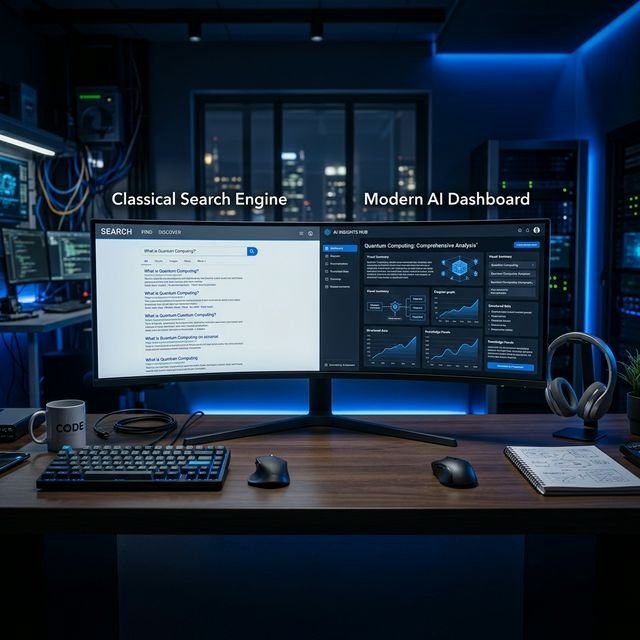
For decades, Google has conditioned us to scan a list of ten blue links, dodge three ads disguised as results, and guess which website actually has the answer. It worked—until it didn’t. In 2026, the friction of ‘clicking and back-tracking’ feels like using a rotary phone in a 5G world.
SearchGPT doesn’t give you a list of sites to visit; it gives you the answer you’re looking for, citing the exact sources it used for every claim. It’s the difference between a librarian pointing to a shelf and a researcher summarizing the book for you. After a week, going back to Google felt like work.
Social Media Search: Why Gen-Z is Moving On
What Google missed—and SearchGPT caught—is that the younger generation has already left. Gen-Z isn’t ‘Googling’ it; they’re ‘TikToking’ it. Why? Because they want visual, immediate, and community-verified information. SearchGPT bridges that gap by providing conversational, easy-to-digest outputs that feel more like a DM from a smart friend than a sterile index.
But here’s the kicker: SearchGPT isn’t limited by the short-form video constraints of social media. It brings the ‘social search’ vibe to high-authority data, and that’s where Google’s massive ad-cluttered engine starts to look like a relic.
The Real-Time Engine: Deep Research in Seconds
One major criticism of early AI models was that they were stuck in the past. Not anymore. SearchGPT’s real-time crawling is frighteningly fast. Whether it’s the latest stock shift or the winner of last night’s game, the context is there instantly. But unlike Google, which often optimizes for ‘Recency’ over ‘Quality’, SearchGPT manages to find the most credible source in the noise.
I tested it with a complex medical research query. Google gave me three ads for clinics and a WebMD page that told me everything was terminal. SearchGPT synthesized two recent peer-reviewed studies and a clinical trial summary, linking directly to the PDFs. That’s game-changing.

The Ad-Free Oasis (For Now)
We have to address the elephant in the room: Ads. Google is an advertising company first and a search engine second. Their business model *depends* on you clicking things that pay them. SearchGPT, at least for now, is focused on the user experience. No ‘Sponsored’ tags, no ‘People also bought’ distractions—just your query and the truth.
Eventually, OpenAI will have to monetize, but their current lead in UX is so vast that Google’s scramble to put ‘AI Overviews’ at the top of their search results feels desperate. Those overviews often just repeat the ads below them, which just doubles the clutter.

Context is King: Why ‘Follow-up’ Changes Everything
The biggest ‘Aha!’ moment of my week was the follow-up feature. When you search on Google, each query is a discrete event. If you want more detail, you have to start a new search. In SearchGPT, you just keep talking. ‘Show me more about that third link’ or ‘Can you simplify the technical part of that answer?’
This conversational memory transforms search from a chore into a dialogue. It’s not just about finding ‘stuff’ anymore; it’s about understanding concepts.
My Personal Verdict
Will Google survive the AI revolution? Probably. They have too much infrastructure to vanish overnight. But will they remain the ‘King’? My final verdict is NO. SearchGPT has proven that we value precision and context over a cluttered list of links. The crown has officially slipped.
Is SearchGPT faster than Google?
In terms of raw speed to load a page, Google is faster. But in ‘Time to Answer’—the time it takes for you to actually find the information you need—SearchGPT wins by a landslide.
Does SearchGPT still hallucinate?
All AI has some risk, but SearchGPT’s heavy reliance on direct web citations significantly reduces hallucinations compared to standard chatbots. It forces itself to ground its answers in the live web.
Is SearchGPT free to use?
Currently, SearchGPT is being rolled out to Plus and Team users, with a wider release expected as OpenAI scales their infrastructure.