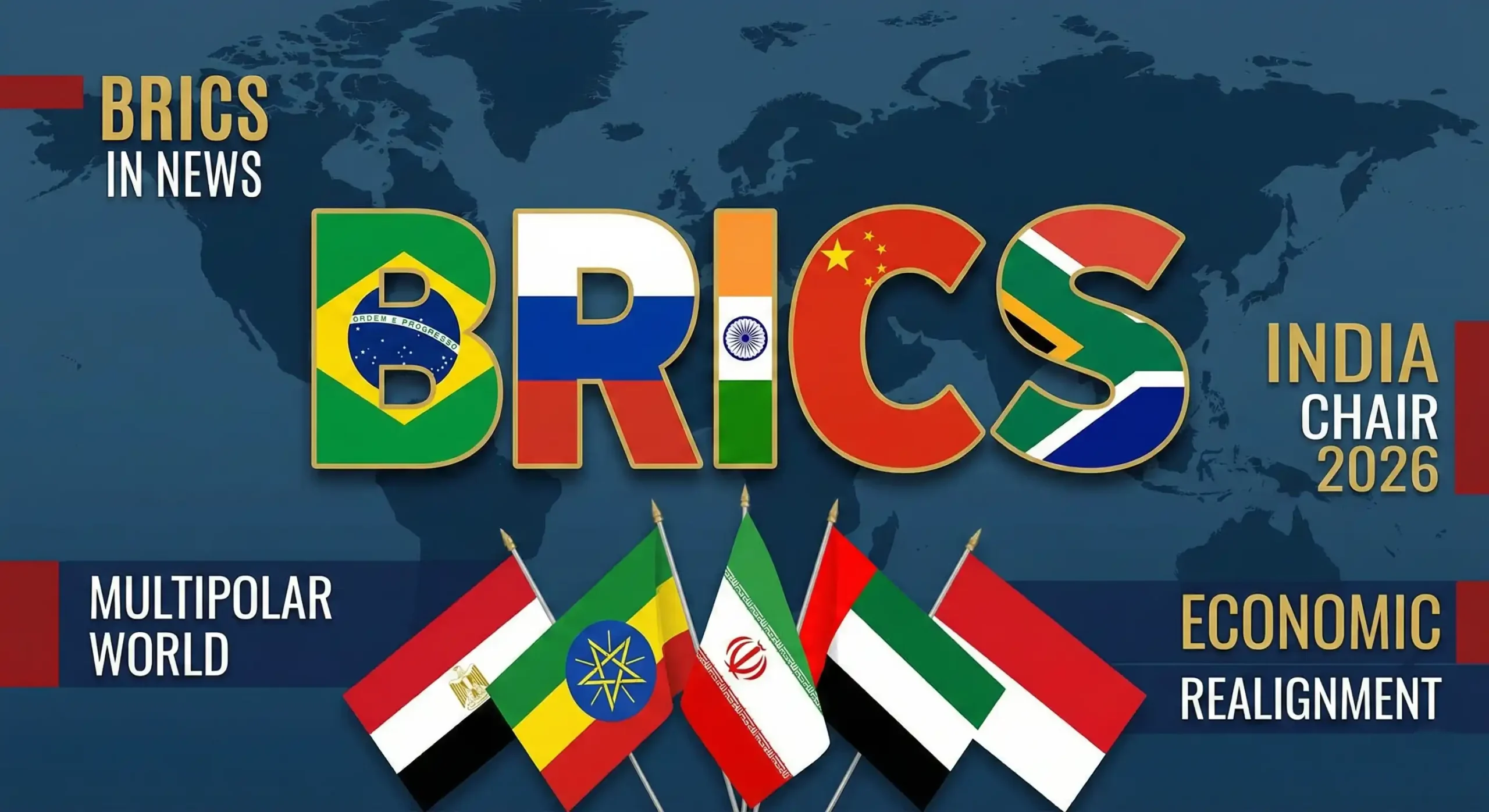
The global order is witnessing a decisive shift from post-Cold War unipolarity towards a multipolar world, driven largely by the rising economic and political assertiveness of the Global South. In this context, the limitations of traditional multilateral institutions have created space for alternative groupings that emphasise strategic autonomy, development cooperation, and inclusive governance. BRICS, with India as a founding member and future chair in 2026, has emerged as a key platform representing the collective aspirations of emerging economies and advocating reforms in global governance structures.
As traditional multilateralism faces fragmentation, emerging economies are gravitating toward alternative forums to secure strategic autonomy. At the heart of this realignment stands BRICS, which has matured from a mere investment acronym into the primary vehicle for the Global South’s collective voice. For India, this grouping is no longer just a diplomatic platform but a critical fulcrum for balancing relations between the East and West, championing the concerns of the developing world, and asserting its own role as a leading architect of this new multipolar era.
India plays a critical “balancing” role in BRICS—preventing the group from becoming a purely anti-Western bloc led by China.
Prime Minister’s Vision: India aims to position BRICS as a “human-centric” group, sharing India’s success in Digital Public Infrastructure (DPI) like UPI with the Global South.
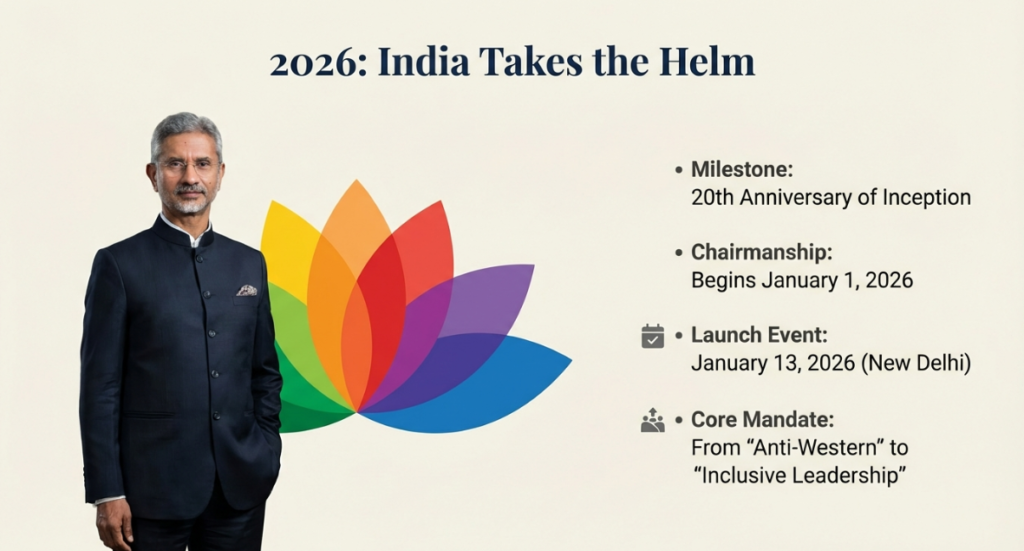
Current Status: India officially assumed the BRICS Chairmanship on January 1, 2026.
Predecessor: Brazil (2025 Chair).
India’s 2026 Theme: Centered on “Resilience, Innovation, Cooperation, and Sustainability”.
1. What is BRICS: Members, Formation, and Objectives
Origins and Evolution: The term “BRIC” was originally coined in 2001 by Goldman Sachs economist Jim O’Neill to describe the economic potential of Brazil, Russia, India, and China. The platform was formalized as a political club in 2006, with the first ministerial meeting held on the sidelines of the UN General Assembly. The inaugural Leaders’ Summit took place in Yekaterinburg, Russia, in 2009.
- Membership Expansion: South Africa joined in late 2010, attending its first summit as a full member in 2011, which changed the acronym to BRICS. In 2024, Egypt, Ethiopia, Iran, and the UAE became full members. Indonesia officially joined on January 6, 2025.
- Current Full Members (10 Core): Brazil, Russia, India, China, South Africa, Egypt, Ethiopia, Iran, UAE, and Indonesia. Note: Saudi Arabia was invited but remains in a state of “persistent deliberation” as of early 2026.
- Core Objectives: The group serves as a political and diplomatic coordination forum aiming to strengthen economic cooperation and reform global governance institutions like the UN, IMF, and World Bank to reflect contemporary realities.
2. India and BRICS: Dr. S. Jaishankar’s Vision and the 2026 Chairmanship
India is a founding pillar of the grouping and officially assumed the rotating BRICS chairmanship on January 1, 2026. This year marks a historic milestone—the 20th anniversary of the group’s inception.
The Official Launch (January 13, 2026): External Affairs Minister (EAM) Dr. S. Jaishankar launched the official website and logo for India’s 2026 Chairship in New Delhi. He emphasized that India approaches its tenure with a “humanity-first” and “people-centric” approach, inspired by Prime Minister Narendra Modi.
Theme: “Building Resilience and Innovation for Cooperation and Sustainability”. This theme underscores four broad priorities:
- Resilience: Building structural institutional strengths to weather global economic and environmental shocks in agriculture, health, and energy supply chains.
- Innovation: Deploying new technologies like AI and promoting India’s Digital Public Infrastructure (DPI) as a scalable model for the Global South.
- Cooperation: Strengthening the forum for dialogue on global security and public health.
- Sustainability: Focusing on green energy transitions and fair climate finance.
Dr. Jaishankar noted that the 2026 logo, featuring a lotus with multicolored petals, represents “unity in diversity” and reflects the distinct identities of all member nations working toward a shared purpose.

3. BRICS Plus: Expansion and Global Weight
The “BRICS Plus” format allows the bloc to engage with non-member states across the Global South. Following the 2024 Kazan Summit, a new “Partner Country” status was introduced to accommodate over 30 interested nations.
- The 10 Partner Countries: Belarus, Bolivia, Cuba, Kazakhstan, Malaysia, Nigeria, Thailand, Uganda, Uzbekistan, and Vietnam.
- Economic Significance: The expanded BRICS+ accounts for approximately 48.5% of the world’s population and nearly 40% of global GDP (PPP). It also controls 44% of global oil reserves and 72% of rare earth mineral reserves.
4. Recent Developments: Military and Strategic Cooperation
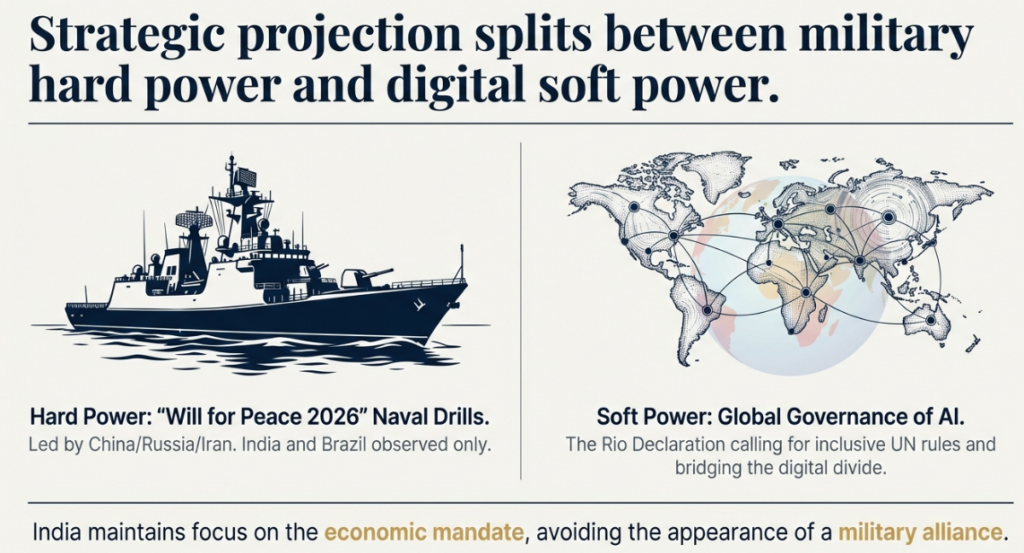
Military Cooperation – “Will for Peace 2026”: In January 2026, a week-long joint naval exercise was held off the South African coastline. Led by China, the drills involved Russia, Iran, and South Africa, focusing on maritime strike simulations and rescue missions. India and Brazil stayed away from active participation, sending only observers or abstaining to maintain their multi-alignment strategies and keep BRICS focused on its economic mandate.
The New Development Bank (NDB): Headquartered in Shanghai and chaired by Dilma Rousseff, the NDB raised $16.1 billion in 2024. It recently approved Colombia and Uzbekistan as new members. The bank emphasizes local-currency financing to shield members from US dollar volatility.
Global Governance of AI: At the 17th Summit in Rio de Janeiro (July 2025), leaders adopted a declaration on AI, calling for the UN to lead in formulating inclusive global rules that bridge the digital divide.
5. India’s Stand on BRICS Currency and De-dollarization
While some members like Russia and Iran push for a common currency to bypass Western sanctions, India maintains a cautious and pragmatic stance.
- National Currency Trade: India prioritizes settling trade in national currencies (e.g., Rupee-based trade) to reduce transaction costs and “derisk” its economy from global shocks.
- Opposition to Common Currency: New Delhi has shunned the idea of a single BRICS currency, viewing it as “outlandish” and wanting to avoid being trapped in a geopolitical confrontation with the West.
- Digital Interoperability: India supports linking national payment systems, such as UPI, with alternatives like BRICS Pay for faster cross-border messaging.
6. Challenges and Criticism of BRICS
- Internal Heterogeneity: The bloc consists of diverse political systems (vibrant democracies like India and Brazil vs. autocracies) and economic sizes.
- India-China Rivalry: Persistent border disputes and China’s dominant economic role within the group often create friction.
- External Pressures: The US administration has threatened 100% tariffs on BRICS countries attempting to replace the dollar with a common currency.
- Institutional Gaps: BRICS lacks a permanent secretariat, a constitutive treaty, or an independent budget.
7. Importance of BRICS for India and the Global South
For India, BRICS is a vital tool for multi-alignment, allowing New Delhi to maintain ties with the West while engaging emerging powers. It provides a stage to display international leadership and status as a “great power” in a multipolar world.
For the Global South, BRICS serves as the primary voice for reforming the UN Security Council and Bretton Woods institutions. It provides an alternative to Western-style “conditionality” in development finance via the NDB.
8. Way Forward and Future Prospects
The success of the bloc now hinges on its ability to move from rhetorical declarations to building structural mechanisms. Key developments to watch in 2026 include:
- BRICS Pay & UNIT: The operational deployment of digital settlement systems.
- The 18th Summit: Hosted by India, this will be a “proving ground” for whether the group can bridge internal contradictions to address shared challenges like climate change and pandemics.
9. Conclusion: Exam-Oriented Summary
BRICS has evolved into a “hedging club” where emerging powers negotiate their place in a shifting global order. India’s 2026 Chairmanship marks a pivot toward inclusive, tech-driven leadership for the Global South under Dr. Jaishankar’s vision of a “reinvigorated, inclusive, and effective multilateral order”. Aspirants should focus on technical initiatives like NDB local currency loans, the UNIT settlement system, and India’s Digital Public Infrastructure (DPI) as they represent the future of the bloc’s institutional strength.
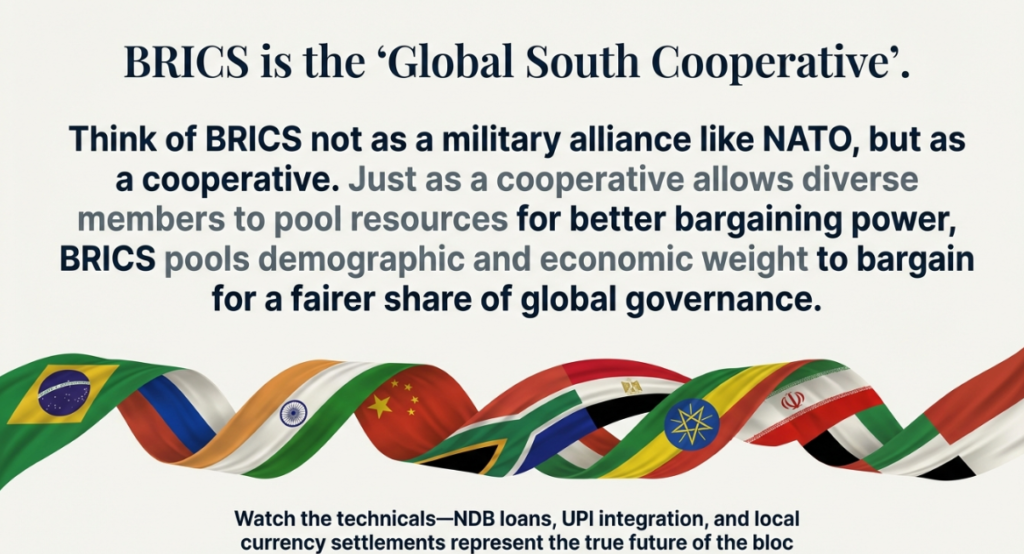
Analogy for Understanding: Think of BRICS not as a military alliance like NATO, but as a “Global South Cooperative.” Just as a cooperative allows diverse members to pool resources for better bargaining power against larger established entities, BRICS allows emerging nations to pool their demographic and economic weight to bargain for a fairer share of global governance.