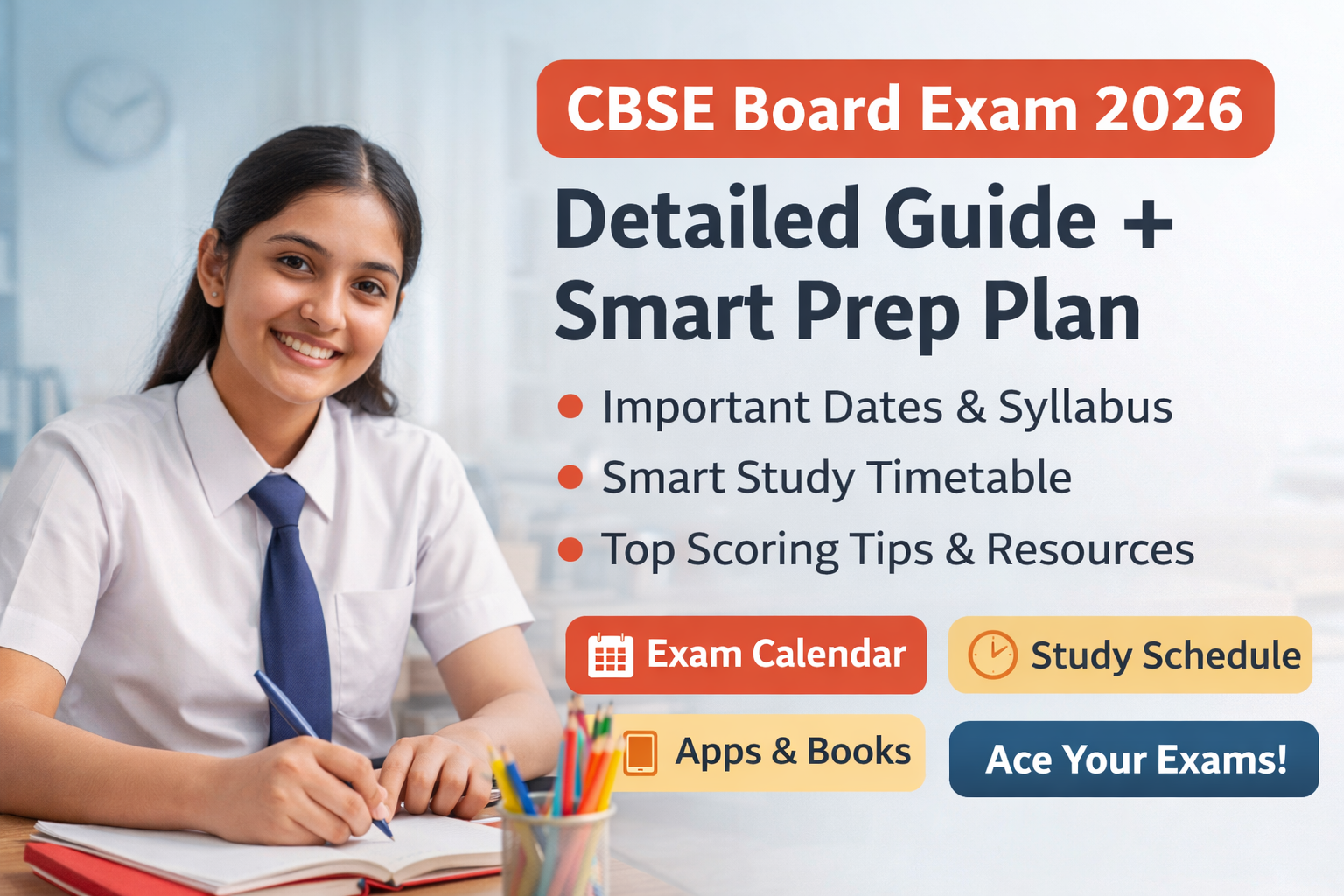
Preparing for the CBSE Board Exam 2026 often feels like a marathon where everyone is shouting different directions at you. New syllabus updates, school pressure, and family expectations can make you wonder if you’re actually doing enough. If that sounds like you, take a deep breath—you are not alone, and you are exactly where you need to be.
This guide is designed as your personal academic mentor. We’ll break down the CBSE Board Exam 2026 date sheet expectations, smart study strategies, and a daily routine that actually fits into your life. Let’s make this year your best one yet.
What to Expect from CBSE in 2026
The Central Board of Secondary Education (CBSE) manages exams for over 35 lakh students globally. For the 2026 cycle, the board is leaning further into competency-based questions. This means the exam will test how well you can apply what you’ve learned to real-world scenarios rather than just how much you can memorize.
CBSE Board Exam 2026: The Expected Timeline
Based on the recent revised schedule and historical trends, here is the timeline you should mark on your calendar:
- Date Sheet Status: Revised schedule for 2026 is out.
- Practical Exams: Expected in January to February 2026.
- Theory Exams Start: February 17, 2026.
- Theory Exams End: March 11, 2026 (Class 10) and April 10, 2026 (Class 12).
Subject-Wise Master Strategy
1. Mathematics (Feb 17) – The Foundation
Since this is your first major paper, you have the most time to prepare now.
- The 80/20 Rule: 80% of marks often come from 20% of high-weightage chapters like Algebra, Trigonometry, and Statistics. Master these first.
- Formula Sheet: Create a one-page “Cheat Sheet” of all formulas and theorems. Read it every morning until Feb 17.
- NCERT Examples: CBSE loves to pick examples directly from the textbook. Don’t skip them for reference books.
2. English (Feb 21) – The Expression
The 3-Day Gap Strategy: You have roughly 3 days after Maths.
- Day 1: Revise all Letter/Notice formats. Format is “free marks.”
- Day 2: Read the Literature chapters as stories. Focus on character sketches—they are critical for long-form competency questions.
- Day 3: Solve one full-length sample paper to check your writing speed.
3. Science (Feb 25) – The Logic
The 3-Day Gap Strategy:
- Physics: Focus on ray diagrams and numericals (Electricity/Light). Practice drawing neat, labeled diagrams.
- Chemistry: Write down every chemical reaction from NCERT and balance them. Understand “reasoning” questions (e.g., Why does the color change?).
- Biology: Master the Life Processes flowcharts. In Bio, a good diagram with labels can get you full marks even if the text is brief.
4. Hindi (Mar 2) – The Accuracy
The 4-Day Gap Strategy: This is a long gap; use it wisely.
- Grammar (Vyakaran): This is the scoring section. Practice Sandhi, Samas, and Muhavare.
- Writing (Lekhan): Practice Anuched and Patra writing. Focus on using clean, formal Hindi vocabulary.
- Literature: Memorize the names of poets and authors for every chapter to add weight to your answers.
5. Social Science (Mar 7) – The Structure
The 4-Day Gap Strategy:
- Map Work: 10 minutes daily. Map marks are guaranteed if you know the locations of ports, dams, and movement centers.
- Headings: Never write long paragraphs. Use Bold Headings and bullet points. Evaluators love structured answers.
- Timeline: For History, create a timeline of major events (1915-1947) to keep the sequence of the National Movement clear.
6. Rescheduled Paper / Vocational (Mar 11) – The Finish
The 3-Day Gap Strategy:
- Focus on Codes: Since this date was changed from March 3rd, ensure you are studying for the correct subject code.
- Competency Focus: Use the final days to solve the latest CBSE Question Bank problems, as these final papers often test application-based thinking.
Pro-Tip for 10:30 AM Timing
Since every exam starts at 10:30 AM, your brain needs to be at its peak at this time.
Use the 15-minute reading time (10:15 – 10:30 AM) to categorize questions: (A) Easy/Direct, (B) Analytical/Time-consuming, (C) Difficult.
A Practical Daily Routine for Success
A study plan only works if it’s realistic. Instead of a 16-hour grind, try this balanced approach:
CBSE Board Exam 2026: Official Revised Timetable
The following schedule reflects the core subjects for both Class 10 and Class 12. Remember, the March 3rd exams were rescheduled, extending the Class 10 cycle to March 11th and Class 12 to April 10th.
Class 10 – Key Subject Schedule
Class 12 – Major Stream Schedule
Note: Always verify your specific subject codes with the official PDF on cbse.gov.in, as vocational and elective subjects may have different durations (e.g., 2 hours).
Strategic Insight: Use the Gaps Wisely
Looking at this schedule, you’ll notice significant gaps between major papers like Science and Hindi for Class 10. Don’t treat these as holidays; use the first half of the gap for a deep-dive revision of the next subject and the second half for solving at least two full-length sample papers to build your writing stamina.
Final Mentor Advice
The CBSE Board Exam 2026 is a significant milestone, but it does not define your entire worth. Trust the process, stick to your NCERT textbooks, and practice consistently. When you walk into that exam hall, do it with the confidence of someone who has planned their work and is now simply working their plan.