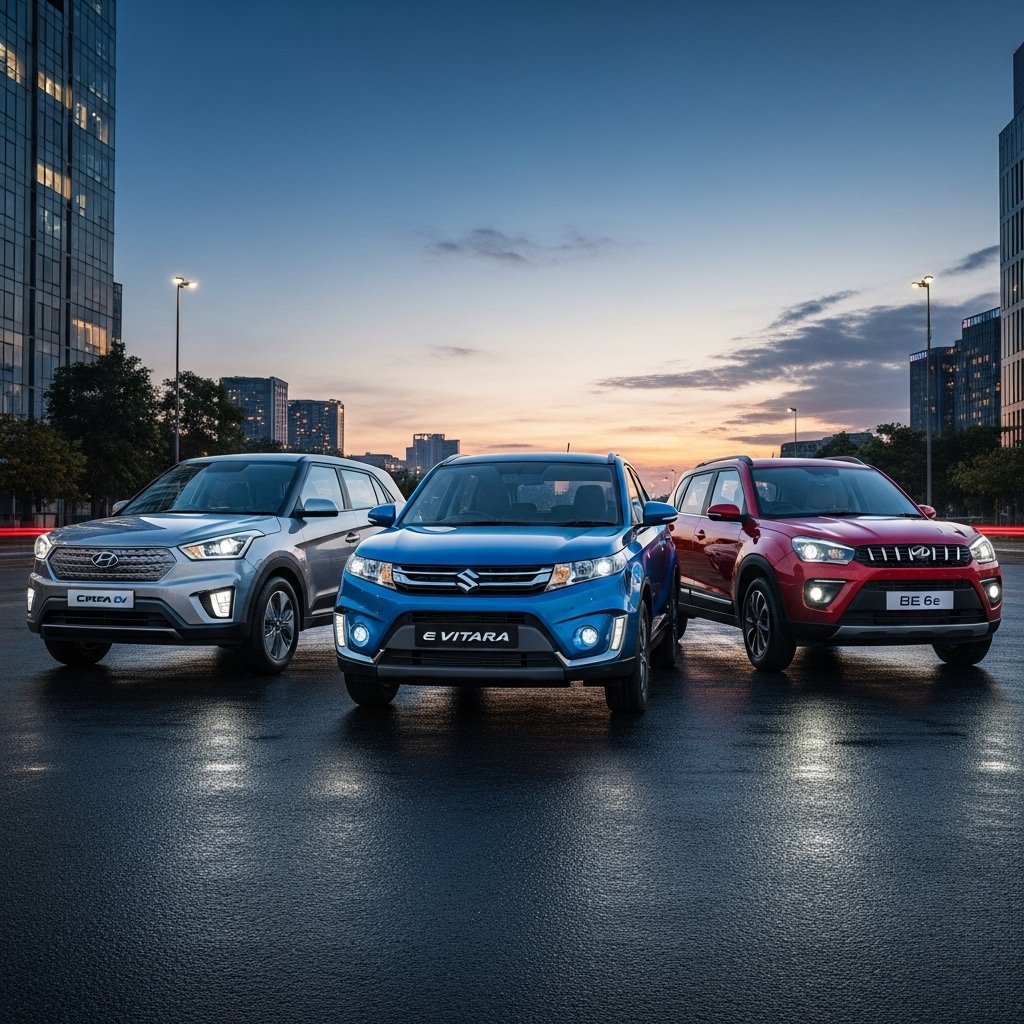

Creta EV vs Maruti e Vitara: The 2026 Electric SUV Battle Explained.
Jan 2026 Update: The Indian EV market has exploded. We compare the new Hyundai Creta EV, Maruti Suzuki e Vitara, and Mahindra BE 6e to help you decide which electric SUV is worth your money.
It is January 2026, and the Indian automotive landscape has officially shifted. For years, we’ve been hearing about the “upcoming” electric revolution from India’s biggest carmakers. That future is no longer a PowerPoint presentation—it is parked right outside our dealership doors.
With the Bharat Mobility Global Expo 2026 kicking off this week in Delhi, the silence has broken. We have the Hyundai Creta EV launching on January 17, the production-ready Maruti Suzuki e Vitara finally revealing its price, and Mahindra’s radical BE 6e already courting buyers with deliveries starting next month.
For the average Indian middle-class buyer, this is a confusing time. Do you stick with the trusted Creta brand in its electric avatar? Do you trust Maruti’s first-ever EV? or do you go for the futuristic flair of Mahindra? As an automotive journalist driving these roads for 15 years, here is my honest, hype-free breakdown of where your money should go.
The “Big Three” Contenders: A Snapshot
We are looking at the mid-size electric SUV segment (₹18 Lakh – ₹25 Lakh bracket), which is currently the hottest property in the Indian market.
1. Hyundai Creta EV: The Safe Bet
- Status: Launching Jan 17, 2026.
- The Vibe: It looks and feels like the Creta we all know, but silent. Hyundai hasn’t messed with the formula.
- Top Spec: Expected 45-50 kWh battery, ~450 km range.
- Why it’s trending: It’s a Creta. For 60% of buyers, that badge alone is enough assurance of resale value and service quality.
2. Maruti Suzuki e Vitara: The Game Changer
- Status: India Debut Jan 2026 (Expo).
- The Vibe: This isn’t just a Grand Vitara with a battery. It’s built on a dedicated EV platform (developed with Toyota). It feels more spacious and modern inside than any Maruti before it.
- Top Spec: 60 kWh battery, ~550 km range, available AWD (All-Wheel Drive).
- Why it’s trending: It’s Maruti’s first EV. The network is massive, and the promised range is higher than the Creta.
3. Mahindra BE 6e: The Wild Card
- Status: Launched (Price ~₹18.90 Lakh), Deliveries Feb 2026.
- The Vibe: It looks like a spaceship. The “coupe” design is polarizing—you either love it or hate it. Inside, it’s a cockpit with screens everywhere.
- Top Spec: 59 kWh / 79 kWh battery options, INGLO platform, RWD (Rear Wheel Drive) fun.
- Why it’s trending: Performance. It’s the driver’s choice in this segment.
Real-World Comparison: What Matters on Indian Roads
When you are stuck in Silk Board traffic in Bengaluru or navigating a flooded subway in Mumbai, specs on paper mean nothing. Here is how they stack up in reality.
1. Range & Charging Anxiety
- Maruti e Vitara (Winner): With a 60 kWh pack and Maruti’s focus on efficiency, you can expect a real-world range of 380-400 km. This is crucial for those weekend trips from Delhi to Jaipur without sweating over chargers.
- Creta EV: Likely to offer ~300-320 km real-world range. It’s adequate for city use and occasional highways, but it lags slightly behind Maruti and Mahindra on long hauls.
- Mahindra BE 6e: The larger 79 kWh battery variant is a beast (450+ km real world), but it will cost significantly more. The standard variant is on par with Maruti.
2. Comfort & Rear Seat Space
- Creta EV (Winner): Hyundai knows comfort. The suspension is tuned for our potholed roads. The floor is slightly raised due to batteries, but the under-thigh support is still the benchmark.
- Maruti e Vitara: Very spacious due to the born-electric platform (flat floor), but interior plastic quality still feels a notch below Hyundai.
- Mahindra BE 6e: The coupe roofline eats into rear headroom. If you have tall parents or drive with a full car often, the back seat might feel claustrophobic compared to the boxy Creta.
3. Tech & Features
- Mahindra BE 6e: Triple screens, cinematic sound, glass roof. It feels like a gadget on wheels.
- Creta EV: Level 2 ADAS, ventilated seats, and that trusty panoramic sunroof. It’s feature-loaded but practical, not gimmicky.
- Maruti e Vitara: A big step up for Maruti with digital dials and a large infotainment screen, but it lacks the “wow” factor of the Mahindra.
Ownership Costs: The “Kitna Deti Hai” of EVs
In 2026, the electricity cost is roughly ₹8-10 per unit in most metros.
| Feature | Hyundai Creta EV | Maruti e Vitara | Mahindra BE 6e |
| Est. Price (Ex-Showroom) | ₹18.00 – ₹26.00 Lakh | ₹19.00 – ₹24.50 Lakh | ₹18.90 – ₹27.00 Lakh |
| Battery Size | ~45 kWh | 49 kWh & 61 kWh | 59 kWh & 79 kWh |
| Real World Range (Est) | 320 km | 380 km | 370 – 450 km |
| Cost Per KM (Home Charge) | ~₹1.20 | ~₹1.10 | ~₹1.30 |
| Service Network | Excellent (Premium feel) | Unbeatable (Everywhere) | Good (Improving) |
Note on Resale: The Creta brand holds value like gold. An Electric Creta is likely to depreciate the slowest among the three.
Verdict: Who Should Buy What?
The market has segmented beautifully. There is no single “best” car, but there is a best car for you.
1. The “Family First” Buyer:
- Go for the Hyundai Creta EV.
- It is familiar, comfortable, and service is hassle-free. If this is your primary car and you have elders in the family, the easy ingress/egress and plush ride make it the winner.
2. The “High Miler” / Practicality Seeker:
- Go for the Maruti e Vitara.
- If you drive 80+ km a day or travel inter-city often, the extra range and Maruti’s rugged suspension setup are vital. It’s a workhorse that happens to be electric.
3. The “Techie” / Enthusiast:
- Go for the Mahindra BE 6e.
- If you want heads to turn and want a car that pushes you back in your seat when you floor the pedal, this is it. It’s a statement piece.
Expert Take
If I were putting my own ₹20 Lakh down today (Jan 15, 2026), I would wait exactly 3 days for the Creta EV price announcement. If Hyundai prices the mid-spec aggressively near ₹18.5 Lakh, it will kill the competition. However, if range is your absolute priority, the Maruti e Vitara (launching later this year but debuting now) is worth the wait for its 60kWh battery pack.
FAQs: 2026 EV Buying Guide
Q1: Is the Maruti e Vitara 4×4?
A: Yes, the top-spec e Vitara will feature an “ALLGRIP-e” electric 4WD system, a first for a compact electric SUV in this mass segment.
Q2: When will deliveries for Creta EV start?
A: Bookings are expected to open alongside the launch at the Bharat Mobility Expo (Jan 17), with deliveries likely beginning in March 2026.
Q3: Is electric charging infrastructure better in 2026?
A: Significantly. While highway charging still requires planning, Tier-1 cities now have reliable fast chargers at most malls and tech parks. However, home charging remains the primary recommendation.
Q4: What is the battery warranty on these cars?
A: Standard industry practice is now 8 years or 1,60,000 km. Both Hyundai and Maruti are expected to match or exceed this to build trust.
Q5: Should I buy the Tata Curvv EV instead?
A: The Tata Curvv EV is a fantastic stylistic competitor. If you prefer the coupe look but find the Mahindra BE 6e too radical, the Curvv is the perfect middle ground.
Next Step: Are you considering booking one of these? I can create a quick Pre-Delivery Inspection (PDI) Checklist specifically for electric vehicles so you know exactly what to check before accepting your new car.