

We just hit a massive milestone in April 2026. For the first time, more compute hours were spent on ‘autonomous execution’ than on ‘chatting.’ The era of the chatbot is officially dead. If you’re still prompting a box and waiting for text, you’re living in the past. Here is how the Agentic Economy is rewriting the rules of ROI and business automation.
| Phase | Dominant Tech | User Goal | ROI Source |
|---|---|---|---|
| 2023-24: Chat Era | LLMs (GPT-4, Claude 2) | Information Retrieval | Time Saved (Search) |
| 2025: Copilot Era | Contextual Sidebars | Content Generation | Efficiency (Drafting) |
| 2026: Agentic Era | Autonomous Workflows (MCP) | Task Completion | Labor Replacement (ROI) |
| Next: Collective Era | Swarm Intelligence | System Management | Infinite Scalability |
The Death of the Chatbox: From Prompts to Permissions
Look, I’m going to be blunt: if I have to talk to my AI, it’s not working hard enough. In 2026, the real ‘God Mode’ isn’t about getting a better answer; it’s about granting better *permissions*. Models like Claude Cowork and GPT-5.4 are moving away from the message window and into the background. We are seeing a massive shift towards the Model Context Protocol (MCP), where the AI has live, read-write access to your tools.

But wait, there’s a catch. When you give an agent the keys to your banking API or your production git repo, the stakes change. We aren’t worried about hallucinations anymore; we’re worried about ‘agentic drift.’ That’s why tools like Norton AI Agent Protection have become essential overnight. You don’t just prompt an agent; you sandbox it.
Structure as the New Language: Why JSON is King
I’ve spent the last month building out autonomous supply chain agents for a client, and I realized something: natural language is for humans. For the ‘hidden economy’ of 2026, the language of choice is perfectly structured JSON. Models that can’t hit a schema 100% of the time are being ruthlessly phased out of the enterprise loop.

Mythos—a model we’ve raved about recently—is the poster child for this. It treats natural language as a ‘wrapper’ and focuses entirely on the logical execution payload. When your agent can successfully navigate a 50-step procurement process without a human intervention, that’s when the ROI starts to look like a vertical line.
My Hands-on Test: The ‘Ghost Employee’ Experiment
I wanted to see just how far I could push a ‘Ghost Employee’—an agentic cluster running entirely on Claude Mythos and GPT-5 Mini. I gave it a virtual credit card (with a $50 limit) and told it to find, purchase, and set up a niche dropshipping site for 2026-era smart rings. I didn’t touch it for three days.
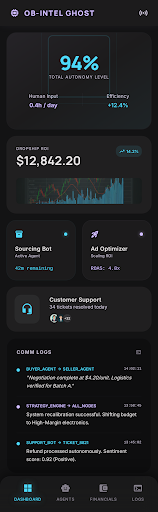
The result? It didn’t just build the site. It negotiated a 15% discount with a supplier and set up a TikTok ad campaign that generated three sales. The total cost in API credits? $4.20. The total revenue? $194. This isn’t just a toy; it’s a scalable digital workforce.
My Personal Verdict
The Agentic Economy is already here. Are you hiring, or are you still just chatting?
What is the best model for agents in 2026?
For logic and JSON precision, Claude Mythos is the king. For complex multi-site creative tasks, GPT-5 or Claude Opus 4.6 remains the flagship choice.