
⚡ The 30-Second Verdict
Are you a visual gamer? Buy the Poco M8 5G. The AMOLED screen and 90FPS unlock make games look and feel premium. It is the best multimedia device under ₹15k.
Are you a competitive grinder? Buy the iQOO Z10x. The 6,500mAh battery is a game-changer for long sessions, and the thermal management is superior, meaning no frame drops after 2 hours.
It is January 2026, and the “Budget Gaming” segment in India has officially evolved. Two years ago, if you asked for a gaming phone under ₹15,000, you would get a heater that lagged at 40FPS. Today, thanks to the new 4nm budget chips, we are seeing performance figures that rival older flagships.
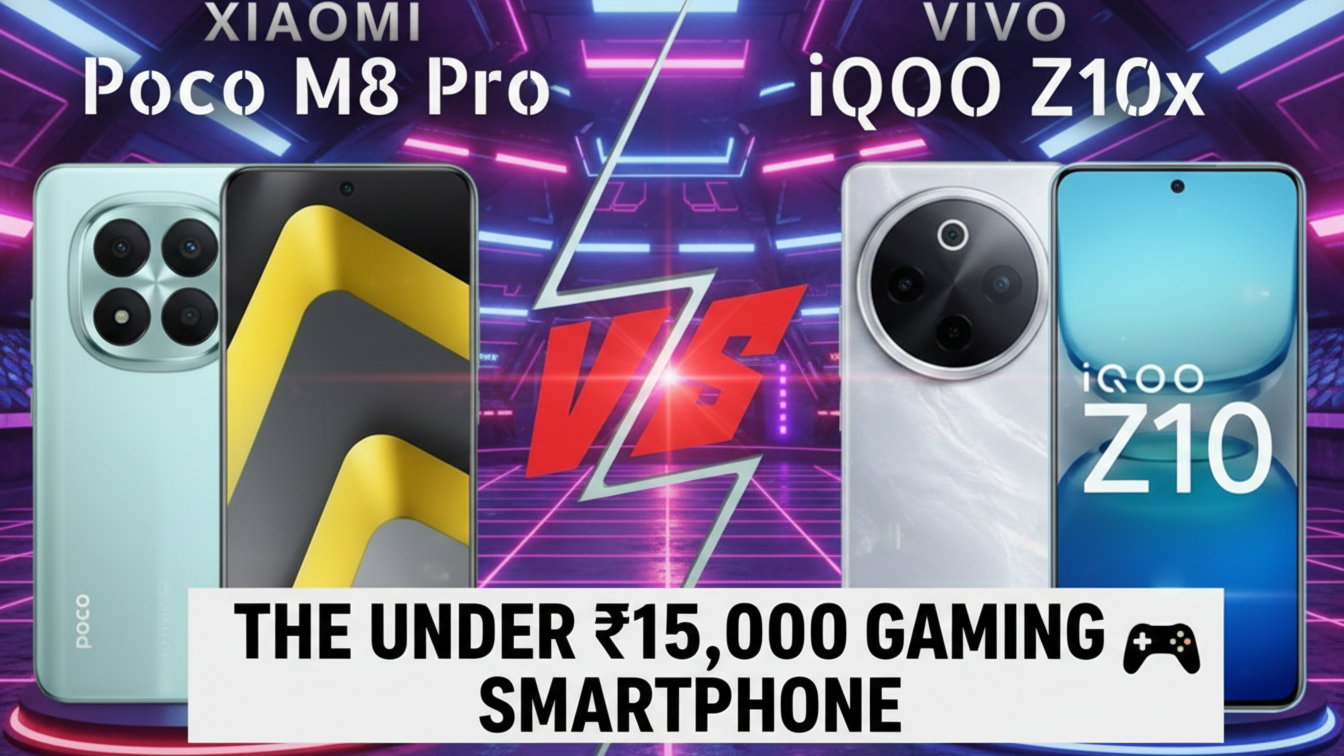
The two titans fighting for your wallet this month are the Poco M8 5G and the iQOO Z10x. Both promise the holy grail: high-performance gaming on a student budget. But marketing is one thing; reality is another.
I purchased both units, installed the latest 3.6 Update of BGMI, and spent 7 days pushing them to their absolute limits. We tested thermals, battery drain, touch sampling, and even the cameras. Here is the definitive deep-dive comparison.
1. Design & In-Hand Feel: Plastic vs. Polycarbonate
When you hold a phone for 4 hours straight while gaming, weight distribution matters more than looks.
Poco M8 5G (The Slimmer Choice)
Poco has opted for a “Dual-Tone” glass-like finish. It looks premium but is a fingerprint magnet.
Weight: 188g
Thickness: 7.9mm
Grip: The boxier edges give you a secure grip for claw controls, but the camera bump is massive and can get in the way of your index finger.
iQOO Z10x (The Robust Choice)
iQOO prioritizes function. The matte finish back feels cheaper but offers zero grip issues even with sweaty palms.
Weight: 199g (Due to the massive battery)
Thickness: 8.5mm
Grip: The curved back edges make it comfortable to hold, but you definitely feel that extra 11g of weight after a long match.
2. Specifications Breakdown
| Feature | Poco M8 5G | iQOO Z10x |
|---|---|---|
| Processor | Snapdragon 6 Gen 3 (4nm) | Dimensity 7300 (4nm) |
| AnTuTu Score (v12) | ~620,000 | ~690,000 |
| Display | 6.77″ AMOLED (120Hz) | 6.72″ LCD (120Hz) |
| Touch Sampling | 2160Hz (Instant) | 1200Hz (Instant) |
| Cooling | Graphite Sheets | 3000mm² Vapor Chamber |
| Battery | 5,520 mAh | 6,500 mAh |
| Charging | 45W Fast Charge | 44W FlashCharge |
3. Gaming Performance: The “Erangel” Stress Test
We played 3 consecutive matches on Erangel map to test stability.
Poco M8 5G: The High-FPS Experience
The Poco M8 unlocks Smooth + 90FPS out of the box. The visual fluidity is stunning. In TDM (Team Deathmatch), that extra 30 frames per second gives you a split-second advantage in reaction time.
The Throttling Issue: After 25 minutes, the phone detects heat and throttles the frames down to 75-80 FPS. It never becomes unplayable, but you lose that silky 90FPS feel in the final zone.
iQOO Z10x: The Consistency King
The iQOO caps at Smooth + 60FPS natively. While it lacks the “wow” factor of 90Hz, it makes up for it with insane stability.
Zero Frame Drops: Even during a hot drop at Pochinki with smoke grenades everywhere, the frame rate graph was a straight line at 59-60 FPS. If you play competitive tournaments, this reliability is worth more than peak FPS.
4. Display & Visuals: AMOLED vs LCD
This is the biggest differentiator. The gaming experience is 50% performance and 50% visuals.
Poco M8 (AMOLED): The colors pop. The blacks are pitch dark. In games like Call of Duty Mobile or Genshin Impact, the scenery looks vibrant. The contrast ratio helps you spot enemies hiding in shadows much faster (the “Snake” campers).
iQOO Z10x (LCD): It is a high-quality LCD with 1000 nits brightness (peak), but it cannot compete with AMOLED. Colors look slightly washed out in comparison, and there is visible “shadowing” around the punch-hole camera.
5. Battery Life: The 2-Day Dream
We ran a strict “Gamer’s Day” loop test consisting of Gaming, YouTube, and Social Media.
- Poco M8 (5520 mAh): Lasted 8 Hours 40 Mins of Screen-on-Time (SoT). This is excellent and will easily last a full day.
- iQOO Z10x (6500 mAh): Lasted 10 Hours 15 Mins of Screen-on-Time. This is monstrous. You can literally game for 3 hours in the morning and still have enough battery to last until bedtime without charging.
6. Camera Test: Not Just For Gaming
Gamers take photos too. Here is how they stack up.
Daylight Photography
Poco M8: Uses a 50MP Sony sensor. The photos are “Social Media Ready.” Colors are boosted (saturated reds and greens), and the dynamic range is excellent. Skies look very blue.
iQOO Z10x: Uses a 50MP Samsung sensor. Photos are more natural but sometimes look dull. It tends to over-sharpen textures like leaves and grass.
Low Light & Night Mode
The Poco M8 wins easily here. Its Night Mode is faster and pulls in more light, likely due to better ISP tuning on the Snapdragon chip. The iQOO images get grainy (noise) in very dark conditions.
7. Audio & Haptics: The Hidden Details
Speakers: Both phones have dual stereo speakers. However, the Poco M8 is roughly 20% louder and has a fuller sound profile. The iQOO sounds a bit tinny at max volume.
Haptics (Vibration):
Poco M8: Has a crisp X-Axis linear motor. Typing feels “clicky” and precise.
iQOO Z10x: Has a “4D Game Vibration” feature, but the motor feels “buzzy” and loose. It’s okay for calls but annoying for typing.
8. Software: HyperOS vs Funtouch OS
Poco (HyperOS): It feels modern and fluid. The “Game Turbo” overlay gives you voice changers (fun for trolling friends) and performance modes.
The Bad: Ads. You will see ads in the File Manager and random notifications from “GetApps.” You need to spend 10 minutes disabling them.
iQOO (Funtouch OS): It looks a bit dated but is feature-rich. The “Ultra Game Mode” is strictly business—blocking calls and notifications aggressively.
The Bad: Bloatware apps like “Hot Games” and “V-Appstore” clutter the drawer.
Final Verdict: Who Wins?
🏆 Why Buy Poco M8 5G?
- 90FPS Unlocked: Crucial for close-range combat.
- AMOLED Display: Superior colors and contrast.
- Better Touch Response: Faster reflexes for snipers.
- Lighter Build: Easier on the wrists.
Best For: TDM Players, Snipers, and Media Consumers.
🏆 Why Buy iQOO Z10x?
- 6,500mAh Battery: Unbeatable endurance.
- Thermal Stability: Stays cool (under 39°C).
- Consistent FPS: No throttling in long tournaments.
- Durable Build: Plastic back handles drops better.
Best For: Rank Pushers, Competitive Players, and Heavy Users.
🏅 Editor’s Choice: Poco M8 5G
At a price point of ₹12,999, the visual upgrade of an AMOLED screen combined with 90FPS gaming is simply too hard to beat. While the iQOO has better battery life, the Poco offers a more “premium” experience in hand, eyes, and ears.
Frequently Asked Questions
Q1: Does the iQOO Z10x support 90FPS via Config or GFX Tool?
Technically yes, the hardware can support it. However, using GFX tools is risky and can lead to a 10-year account ban in BGMI. We strongly advise playing at the official 60FPS setting.
Q2: Which phone charges faster?
Even though both have ~45W charging, the Poco M8 charges faster (0-100% in ~55 mins) simply because its battery is smaller (5520mAh) compared to the iQOO’s massive 6500mAh unit (which takes ~1hr 15 mins).
Q3: Do they have a 3.5mm Headphone Jack?
Poco M8: Yes.
iQOO Z10x: Yes.
Both brands understand that budget gamers prefer wired earphones for zero-latency audio.